

Fine Chemical Pneumatic Flange Ball Valve is a valve specially designed for the fine chemical industry, Fine Chemical Pneumatic Flange Ball Valve has the following features:
Lining material: The valve is lined with fluoroplastic, which has extremely high chemical stability and corrosion resistance, and can resist the erosion of various corrosive media such as strong acids, alkalis, and organic solvents.
Drive mode: It is driven by pneumatic mode, which can be controlled remotely and is convenient for automatic operation. At the same time, the pneumatic drive has the characteristics of fast opening and closing, which can meet the requirements of rapid response in the fine chemical industry.
Structural features: The valve adopts a spherical opening and closing structure, which has good sealing performance and can achieve zero leakage closure. Additionally, the valve has a smooth interior that prevents media buildup, reducing the likelihood of clogging and fouling.
Scope of application: Fine chemical fluorine-lined pneumatic ball valves are widely used in fine chemicals, petroleum, pharmaceuticals, food and other fields, especially for occasions that require high reliability and high safety.
Fine chemical pneumatic flange ball valve is a highly reliable and high-performance valve that can meet the high requirements of the fine chemical industry for media treatment and provide safe and reliable fluid control for the piping system during production.
| name | Fine chemical pneumatic flange ball valve |
| It is called the path | DN15-DN200mm |
| Nominal pressure | 1.6Mpa (If you need other pressure standards, please specify when ordering) |
| Connection | Quick assembly, clamps, quick cards, chucks |
| Body material | Carbon Steel (C) Stainless Steel 304 (P) Stainless Steel 316 (R) |
| Surface treatment | Inner mirror polishing, outer borax process |
| Sealed material | Teflon (PTFE), EPDM, Silicone Rubber (VMQ), Butadiene Rubber (NBR), Fluorinated Rubber (FPM), Metal Seals (H), Carbide (Y) |
| Use the medium | Gas, liquid, oil, vacuum, water vapor |
| Medium temperature | -20℃-150℃(F) 、 -20℃-250℃ (PPL) 、-29℃-425℃(H)(Y) |
| apply | This type of ball valve series is a hygienic type of valve series for material transfer control. It is widely used in food and beverage processing, as well as in the pharmaceutical and chemical industries |
| standard | DIN standard series, 3A standard series SMS standard series, ISO/IDF standard series, BS/RJT standard series, ASME/BPE, etc. (There are various standard valve series that can be provided to customers) |
| The components of ball valves generally include: | A handle, a ball with a through cavity, valve body, valve core and shaft seal |
| Model representation method | ||||||||||||
| WH | -600 | —Q1 | —C1 | —F | —16 | —P | —25 | —D1 | —B | —W2 | —B2 | —L |
| >1. Weiheng brand | >2. Drive mode | >3. Valve body type | >4. Connection method | >5. Sealing material | >6. Nominal pressure | >7. Valve body material | >8. Nominal diameter | >9. Control mode | >10. Explosion-proof level | —20~150℃ | >12. Accessory options | >13. Three flows |
| 1~7 mandatory options, 8~13 optional | ||||||||||||
| 1 codename | 5 codename | Sealed material | 10 code | Explosion-proof rating | |
| WH | Weiheng brand | F | PTFE | B | ExdIl BT4 Gb explosionproof and explosion-proof type |
| PPL | Para-polyphenylene | BZ | ExdllCT5 Gb explosion-proof and explosion-proof type | ||
| 2 codename | Drive mode | H | Metal hard seal | BC | Exdll CT6 Gb explosionproof and explosion-proof type |
| 600 | Pneumatic actuator series | Y | cemented carbide | BM | ExmbllT4 Gb cast explosion-proof type |
| 900 | Electric actuator system | X1 | Ding Qing rubber NBR | BA | Exiall CT6Ga intrinsically safe and explosion-proof |
| 2001 | Column plastic actuator angle seat valve series | X2 | Natural rubber NR | ||
| 2002 | Stainless steel actuator angle seat valve series | X3 | EPDM | 11 codenames | Medium temperature |
| X4 | Viton rubber FPM | W1 | -20-80C | ||
| 3 codename | Body type | X5 | Food grade silicone rubber SI | W2 | -20-150C |
| Q1 | Two-way valve | F46 | Fully lined polyperfluoroethylene FEP | W3 | -20-250C |
| Q2 | Three-way valve | PFA | Fully lined with soluble PTFE PFA | W4 | -29-425C |
| Q3 | Four-way valve | F4 | Fully lined PTFE | W5 | -29-650C |
| Q4 | Stationary ball valve | N | nylon | W6 | -196-60C |
| Q5 | V-ball | TC | Lined ceramic | ...... | ...... |
| Q6 | Low profile ball valve | J | Rubber lining | It has a special temperature that can be designed and manufactured according to customer requirements | |
| Q7 | Sanitary grade ball valves | PEEK | Polyether ether ketone | ||
| Q8 | Plastic ball valves | W | When the ring | 12 codenames | Accessory selection |
| Q9 | High Vacuum Ball Valve | ...... | ...... | B1 | 2-position, 3-way solenoid valve |
| Q10 | Fluorine ball valve in the whole village | Other special sealing materials can be designed and manufactured according to customer requirements | B2 | 2-position 5-way solenoid valve | |
| Q11 | Cryogenic ball valves | B3 | 2-position 3-way explosion-proof solenoid valve | ||
| Q12 | Insulated ball valve | 6 codename | Nominal pressure | B4 | 2-position 5-way explosion-proof solenoid valve |
| Q13 | Eccentric hemispherical valve | ...... | ...... | B5 | Filter pressure reducing valve |
| Q14 | Tank bottom valve | B6 | Limit switch | ||
| Q15 | Ceramic ball valves | 7 codename | Body material | B7 | Explosion-proof limit switch |
| D1 | Centerline soft-sealed butterfly valve | Q | Ductile iron HT200 | B8 | Hand manipulation mechanism |
| D2 | 3. Eccentric butterfly valve | C | carbon steel | B9 | Locator |
| D3 | Sanitary Butterfly Valve | P | Stainless steel 304 | ...... | ...... |
| D4 | Plastic butterfly valve | R | Stainless steel 316 | ||
| D5 | Ventilation butterfly valve | PL | Stainless steel 304L | 13 codenames | Three flows |
| D6 | Fluorine butterfly valve in the whole village | RL | Stainless steel 316L | L | Tee L-type BC switching |
| D7 | High vacuum butterfly valve | U | PVC UPVC | T1 | Tee T-type C-port switch |
| D8 | Powder butterfly valve | PP | Reinforced polypropylene RPP | T2 | Tee T-type AB switching |
| Z1 | Gate valve | L | Aluminum alloy | T3 | Tee T-type AC switching |
| Z2 | Knife gate valve | ...... | ...... | T4 | Tee T-type B-port switch |
| J1 | Globe valve | Other special valve body materials can be designed and manufactured according to customer requirements | |||
| J2 | Bellows cut stop valve | ||||
| J3 | Angle seat valve | 8 codename | It is called the path | ||
| F1 | Upward expansion discharge valve | ...... | ...... | ||
| F2 | Downward discharge valve | ||||
| Other special valve body materials can be designed and manufactured according to customer requirements | 9 code | Control mode | |||
| Z | Standard switch type | ||||
| 4 codenames | Connection | T1 | Integral switching type | ||
| C1 | Female thread | T2 | Overall adjustment | ||
| C2 | By order | T3 | RS485 bus type | ||
| C3 | Male thread | D1 | Double acting | ||
| C4 | flange | D2 | Double-acting adjustment type | ||
| C5 | KF vacuum chuck | E1 | Uni-acting normally closed | ||
| C6 | weld | E2 | Single-acting normally closed regulation type | ||
| C7 | Pair clip | E3 | Single-acting and always open | ||
| C8 | Clamps | E4 | Single-acting normally open adjustment type | ||
Fine Chemical Pneumatic Flange Ball Valve: Comprehensive Guide
The Fine Chemical Pneumatic Flange Ball Valve is designed for precise control and reliable performance in the demanding environments of the fine chemical industry. With its pneumatic actuation and flanged connections, this valve offers fast and efficient control of liquid and gas flows, while maintaining a secure and leak-proof seal. Constructed with high-quality materials, it provides excellent corrosion resistance, making it ideal for handling aggressive chemicals, solvents, and high-pressure fluids commonly used in fine chemical processes.
In this comprehensive guide, we will explore the key features, usage precautions, maintenance methods, and best usage suggestions for the Fine Chemical Pneumatic Flange Ball Valve, helping you get the most out of this versatile and durable valve.
The Fine Chemical Pneumatic Flange Ball Valve offers several key advantages that make it an ideal solution for the fine chemical industry. Below are the main product highlights:
| Feature | Benefit |
|---|---|
| Pneumatic Actuation | Provides quick and reliable control of flow with minimal manual intervention. |
| Flanged Connections | Ensures secure and leak-proof installation for high-pressure systems. |
| Corrosion-Resistant Materials | Resists harsh chemicals and solvents, ensuring durability and long service life. |
| Ball Valve Mechanism | Offers precise on/off control and flow regulation. |
| High-Temperature Resistance | Suitable for high-temperature applications, maintaining performance under extreme conditions. |
| Compact Design | Space-saving and easy to install in tight spaces or confined areas. |
The valve’s high-quality materials (such as stainless steel or other alloys) offer superior corrosion resistance, making it ideal for handling aggressive chemicals in processes like chemical synthesis, pharmaceutical production, and water treatment. Its pneumatic actuation further enhances its ability to withstand harsh conditions, reducing maintenance needs and downtime.
The pneumatic actuation system allows for fast opening and closing, reducing the risk of system downtime. Whether used for on/off or flow throttling applications, the valve provides precise control, enabling efficient fluid management.
This valve is designed to function reliably under high-pressure and high-temperature conditions. It is particularly useful in industries where processes require fluid flow control under such extreme conditions, such as in refining or chemical reaction control.
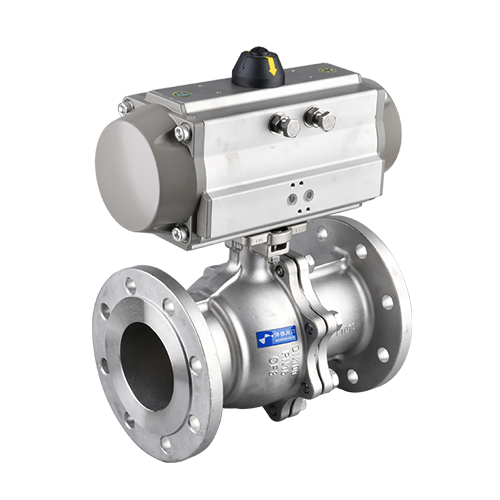
Proper handling and installation of the Fine Chemical Pneumatic Flange Ball Valve are essential for maximizing its performance and longevity. Below are important usage precautions to keep in mind:
Before installation, ensure that the valve material is compatible with the chemicals or fluids it will be handling. Corrosion-resistant coatings or lining materials such as PTFE or PFA are often used to enhance chemical resistance.
Verify that the valve is installed in the correct orientation. The flow direction should match the indication on the valve body to ensure correct operation. The ball valve mechanism needs to function in the appropriate direction to provide accurate flow control.
When installing the valve, ensure that the flanged connections are tightened securely but avoid over-tightening, as this can cause damage to the gaskets or seals, leading to leaks. Use a torque wrench to achieve proper tightening torque.
Ensure that the operating conditions (such as pressure and temperature) are within the specified limits for the valve. Exceeding these limits could cause damage to the valve’s internal components or reduce its lifespan.
The pneumatic actuator should be regularly inspected for signs of wear, leaks, or damage. Check the actuator’s air supply to ensure it is functioning properly. Any issues with the actuator could result in malfunctioning valve performance.
Proper maintenance is critical to ensure the Fine Chemical Pneumatic Flange Ball Valve continues to function optimally. Below are the essential maintenance methods to keep your valve in top condition:
Regularly clean the valve to remove any chemical buildup, debris, or particulate matter that might affect its performance. Cleaning can be done using non-abrasive solvents to prevent damage to the valve’s surfaces and internal mechanisms.
Remove external contaminants from the valve’s body and flanges.
Clean the ball valve mechanism to ensure smooth operation.
Check the pneumatic actuator for dust and dirt buildup, which could affect performance.
The pneumatic actuator and the ball valve mechanism should be lubricated at regular intervals to reduce friction and prevent wear. Use the recommended lubricants for each component to maintain smooth and reliable operation.
Inspect the valve seals and gaskets regularly for signs of wear or damage. Seals are essential for preventing leaks, so damaged seals must be replaced immediately. Use high-quality, chemical-resistant seals that match the valve’s material for the best performance.
Perform regular tests to ensure the valve operates as expected. This includes checking the opening and closing cycle of the valve, as well as verifying that the pneumatic actuator responds properly. Conduct a leak test to detect any possible failures in the sealing system.
Open and close the valve several times to check for smooth operation.
Test the electromagnetic feedback system (if applicable) to ensure accuracy.
Perform a pressure test to ensure the valve maintains a secure seal under normal operating conditions.
Periodically calibrate the pneumatic actuator to ensure that it is correctly controlling the flow of fluids. This helps prevent errors in signal feedback and ensures the valve opens and closes at the correct times.
To ensure the optimal performance and longevity of your Fine Chemical Pneumatic Flange Ball Valve, follow these best usage practices:
Always monitor the performance of the valve during operation. Regular checks on the air supply, actuator, and valve seals help identify potential issues before they result in costly downtime.
Ensure that the entire piping system remains free from contaminants or buildup. Clean the system regularly to prevent blockages and ensure the valve continues to operate effectively.
Ensure that the pressure in the system remains within the valve's rated limits. Overpressurization can cause damage to the valve and its internal components.
When seals, gaskets, or other parts show signs of wear, replace them promptly to avoid leaks and maintain valve performance.
Select the appropriate valve material and design based on the specific application. For fine chemicals and aggressive fluids, valves with fluorine linings or other chemical-resistant coatings are essential to ensuring long-lasting operation.
The Fine Chemical Pneumatic Flange Ball Valve offers outstanding performance and reliability in handling aggressive chemicals and fluids in the fine chemical industry. With its pneumatic actuation, corrosion-resistant materials, and precise flow control, this valve is ideal for high-pressure systems where durability and efficiency are crucial. By following proper installation procedures, maintenance practices, and usage suggestions, you can ensure the long-lasting reliability of your valve.
Tel: +86 577 8699 9257
Tel: +86 135 8786 5766 /+86 137 32079372
Email: wzweiheng@163.com
Address:No. 1633, Yidaoba Road, Binhai Industrial Park, Wenzhou City, Zhejiang Province

Scan wechat
This website uses cookies to ensure you get the best experience on our website.
 Español
 Portugues
 Pусский
 Français
 Deutsch
 한국어
한국어 العربية
 Italiano
 ไทย
ไทย Türk dili
 हिन्दी
 Melayu
 Tiếng Việt
 dansk
dansk қазақ
қазақ বাংলা
বাংলা українська
 Filipino
 o'zbek



 Phone
Phone