

Pneumatic Antimix Valve
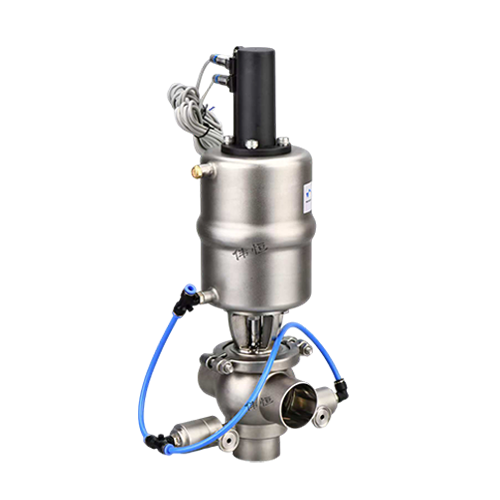
The Pneumatic Antimix Valve is an essential component for applications where the isolation of different fluid streams is critical. Designed to prevent the mixing of fluids, this valve is widely used in industries such as chemical processing, water treatment, and pharmaceuticals. By using pneumatic actuation, the valve ensures fast, reliable, and precise flow control, making it ideal for systems that require strict separation of substances. Its durable construction and simple design allow for easy installation, operation, and maintenance.
This valve is ideal for applications requiring high-pressure and high-temperature resistance, ensuring optimal performance in demanding environments. Whether you are managing toxic chemicals, water distribution, or high-purity processes, the Pneumatic Antimix Valve helps ensure system integrity, safety, and efficiency.
Prevents fluid mixing in systems where purity is essential.
Guarantees that separate pipeline systems remain isolated from each other, avoiding cross-contamination.
Suitable for applications in chemical reactors, water filtration, and multi-phase fluid systems.
Operated by pneumatic actuators, offering precise control of fluid flow.
Can be easily integrated with automated control systems like SCADA and PLC for remote operation.
Quick-response actuation helps in managing flow switching, ensuring immediate isolation when required.
Manufactured with corrosion-resistant materials, ensuring a long service life in harsh environments.
Valve body is typically made from stainless steel, with FDA-approved seals for compatibility in food and pharmaceutical applications.
Designed to withstand high pressure (up to 40 bar) and high temperatures (up to 180°C).
Compact design allows for easy installation in tight spaces.
Offers reliable operation with minimal maintenance requirements.
Modular construction for ease of repair and part replacement.
Pneumatic actuators are energy-efficient compared to electric alternatives, making them cost-effective in long-term operation.
The valve's design minimizes energy consumption by requiring only minimal air pressure to operate.
The Pneumatic Antimix Valve comes with a range of technical specifications to meet diverse application needs. Below is a table summarizing the valve's key parameters:
| Specification | Details |
|---|---|
| Valve Type | Pneumatic Antimix Valve |
| Material | SS304, SS316L, Cast Iron |
| Seal Material | PTFE, EPDM, NBR |
| Pressure Rating | 0-40 bar (PN40) |
| Temperature Range | -10°C to 180°C |
| Flow Control | On/Off, Modulating |
| Actuation Type | Pneumatic (Spring-return or Double-acting) |
| Valve Size | 1” to 12” (DN25 to DN300) |
| Connection Type | Flanged, Threaded, Butt-weld |
| Operating Air Pressure | 4 to 8 bar |
| IP Rating | IP65 (dust and water-resistant) |
| Flow Coefficient (Cv) | 25 to 400 |
| Automation Interface | PLC, SCADA, DCS Integration |
Proper maintenance ensures that the Pneumatic Antimix Valve continues to operate reliably and efficiently throughout its service life. Regular checks and timely maintenance help prevent system downtime and costly repairs.
Inspect the valve body and seals for signs of wear or damage, especially in high-stress applications.
Check the pneumatic actuator for proper functioning, including verifying air supply pressure and actuator response.
Inspect the actuation mechanism for any obstructions or mechanical issues that could impact valve movement.
Apply lubricants to the actuator’s moving parts as specified by the manufacturer to ensure smooth operation.
Lubricate threads and seals periodically to prevent friction and leakage.
Clean the valve body and actuator regularly, especially in industries where fluid cleanliness is critical (e.g., food and beverage).
Use compatible cleaning agents that do not degrade the material of the valve or seals.
| Task | Frequency |
|---|---|
| Inspect Valve and Actuator | Every 3 to 6 months, or after high-stress usage |
| Lubricate Moving Parts | Every 6 months or as needed |
| Seal Replacement | Every 12 to 24 months, depending on the application |
| Clean Valve Body | As per process cleanliness requirements, or quarterly |
| Issue | Possible Cause | Solution |
|---|---|---|
| Valve not responding | Faulty actuator or insufficient air pressure | Check air supply and actuator functionality |
| Leaking seals | Worn or damaged seals | Replace seals with genuine parts |
| Sticking valve | Dirt or debris in valve or actuator | Clean the valve and actuator thoroughly |
| Uneven or reduced flow | Blockage or obstruction | Check for clogs and clear pipeline |
Ensure that the valve body is properly aligned with the pipeline before tightening bolts to avoid mechanical stress.
Install appropriate seals and gaskets based on the type of fluid and temperature in the system.
Connect the pneumatic actuator to the air supply, ensuring that the system is free of moisture and that the correct operating pressure is supplied.
Activate the actuator via a PLC or manual control to either open or close the valve. In modulating control applications, the valve will adjust the flow of the fluid based on signals from the control system.
Monitor the valve using position indicators to verify that it is in the correct position (open or closed).
Adjust the actuation signals based on real-time system requirements.
After use, ensure that the actuator is returned to the neutral position (closed or isolated) when not in operation.
Perform a final inspection to ensure there is no leakage and that the valve remains fully operational.
The Pneumatic Antimix Valve is a reliable and efficient solution for preventing the mixing of fluids in industrial applications. With its pneumatic actuation, durable construction, and compact design, it offers high performance in demanding environments such as chemical processing, water treatment, and pharmaceutical production. Its easy maintenance and energy-efficient operation make it a cost-effective choice for industries where fluid isolation is critical.
By choosing the Pneumatic Antimix Valve, you ensure system integrity, reliable performance, and long-lasting operation, making it an essential component for fluid control in complex industrial systems.
Tel: +86 577 8699 9257
Tel: +86 135 8786 5766 /+86 137 32079372
Email: wzweiheng@163.com
Address:No. 1633, Yidaoba Road, Binhai Industrial Park, Wenzhou City, Zhejiang Province

Scan wechat
This website uses cookies to ensure you get the best experience on our website.
 Español
 Portugues
 Pусский
 Français
 Deutsch
 한국어
한국어 العربية
 Italiano
 ไทย
ไทย Türk dili
 हिन्दी
 Melayu
 Tiếng Việt
 dansk
dansk қазақ
қазақ বাংলা
বাংলা українська
 Filipino
 o'zbek



 Phone
Phone