

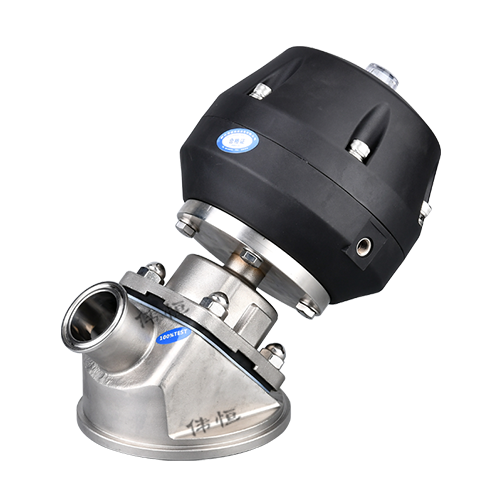
A pneumatic head Tank Bottom Diaphragm Valve is a special type of valve commonly used in chemical, pharmaceutical, and other situations where the flow of gases or liquids needs to be controlled. This valve is mainly composed of a valve body, diaphragm and pneumatic actuator. The valve body is a closed housing, the diaphragm is an elastic membrane that can be bent, and the pneumatic actuator is a device that can control the movement of the diaphragm.
When the pneumatic actuator receives a signal, it drives the diaphragm to move, allowing the valve to open or close. Since the diaphragm is isolated from the fluid medium, it is effective in preventing fluid leakage and contamination. Additionally, pneumatic actuators allow for precise control and adjustment due to their high control accuracy.
Pneumatic head tank bottom diaphragm valves have many applications in the chemical and pharmaceutical industries, such as controlling the flow of gases in equipment such as fermenters, reactors, storage tanks, etc. Due to its advantages such as simple structure, easy operation, and good sealing performance, pneumatic head tank bottom diaphragm valves have become a common valve in these industries.
The pneumatic head tank bottom diaphragm valve is a special type of valve with the advantages of simple structure, easy operation, and good sealing performance, and is widely used in chemical, pharmaceutical, and other occasions where the flow of gas or liquid needs to be controlled.
| Model representation method | ||||||||||||
| WH | -600 | —Q1 | —C1 | —F | —16 | —P | —25 | —D1 | —B | —W2 | —B2 | —L |
| >1. Weiheng brand | >2. Drive mode | >3. Valve body type | >4. Connection method | >5. Sealing material | >6. Nominal pressure | >7. Valve body material | >8. Nominal diameter | >9. Control mode | >10. Explosion-proof level | —20~150℃ | >12. Accessory options | >13. Three flows |
| 1~7 mandatory options, 8~13 optional | ||||||||||||
| 1 codename | 5 codename | Sealed material | 10 code | Explosion-proof rating | |
| WH | Weiheng brand | F | PTFE | B | ExdIl BT4 Gb explosionproof and explosion-proof type |
| PPL | Para-polyphenylene | BZ | ExdllCT5 Gb explosion-proof and explosion-proof type | ||
| 2 codename | Drive mode | H | Metal hard seal | BC | Exdll CT6 Gb explosionproof and explosion-proof type |
| 600 | Pneumatic actuator series | Y | cemented carbide | BM | ExmbllT4 Gb cast explosion-proof type |
| 900 | Electric actuator system | X1 | Ding Qing rubber NBR | BA | Exiall CT6Ga intrinsically safe and explosion-proof |
| 2001 | Column plastic actuator angle seat valve series | X2 | Natural rubber NR | ||
| 2002 | Stainless steel actuator angle seat valve series | X3 | EPDM | 11 codenames | Medium temperature |
| X4 | Viton rubber FPM | W1 | -20-80C | ||
| 3 codename | Body type | X5 | Food grade silicone rubber SI | W2 | -20-150C |
| Q1 | Two-way valve | F46 | Fully lined polyperfluoroethylene FEP | W3 | -20-250C |
| Q2 | Three-way valve | PFA | Fully lined with soluble PTFE PFA | W4 | -29-425C |
| Q3 | Four-way valve | F4 | Fully lined PTFE | W5 | -29-650C |
| Q4 | Stationary ball valve | N | nylon | W6 | -196-60C |
| Q5 | V-ball | TC | Lined ceramic | ...... | ...... |
| Q6 | Low profile ball valve | J | Rubber lining | It has a special temperature that can be designed and manufactured according to customer requirements | |
| Q7 | Sanitary grade ball valves | PEEK | Polyether ether ketone | ||
| Q8 | Plastic ball valves | W | When the ring | 12 codenames | Accessory selection |
| Q9 | High Vacuum Ball Valve | ...... | ...... | B1 | 2-position, 3-way solenoid valve |
| Q10 | Fluorine ball valve in the whole village | Other special sealing materials can be designed and manufactured according to customer requirements | B2 | 2-position 5-way solenoid valve | |
| Q11 | Cryogenic ball valves | B3 | 2-position 3-way explosion-proof solenoid valve | ||
| Q12 | Insulated ball valve | 6 codename | Nominal pressure | B4 | 2-position 5-way explosion-proof solenoid valve |
| Q13 | Eccentric hemispherical valve | ...... | ...... | B5 | Filter pressure reducing valve |
| Q14 | Tank bottom valve | B6 | Limit switch | ||
| Q15 | Ceramic ball valves | 7 codename | Body material | B7 | Explosion-proof limit switch |
| D1 | Centerline soft-sealed butterfly valve | Q | Ductile iron HT200 | B8 | Hand manipulation mechanism |
| D2 | 3. Eccentric butterfly valve | C | carbon steel | B9 | Locator |
| D3 | Sanitary Butterfly Valve | P | Stainless steel 304 | ...... | ...... |
| D4 | Plastic butterfly valve | R | Stainless steel 316 | ||
| D5 | Ventilation butterfly valve | PL | Stainless steel 304L | 13 codenames | Three flows |
| D6 | Fluorine butterfly valve in the whole village | RL | Stainless steel 316L | L | Tee L-type BC switching |
| D7 | High vacuum butterfly valve | U | PVC UPVC | T1 | Tee T-type C-port switch |
| D8 | Powder butterfly valve | PP | Reinforced polypropylene RPP | T2 | Tee T-type AB switching |
| Z1 | Gate valve | L | Aluminum alloy | T3 | Tee T-type AC switching |
| Z2 | Knife gate valve | ...... | ...... | T4 | Tee T-type B-port switch |
| J1 | Globe valve | Other special valve body materials can be designed and manufactured according to customer requirements | |||
| J2 | Bellows cut stop valve | ||||
| J3 | Angle seat valve | 8 codename | It is called the path | ||
| F1 | Upward expansion discharge valve | ...... | ...... | ||
| F2 | Downward discharge valve | ||||
| Other special valve body materials can be designed and manufactured according to customer requirements | 9 code | Control mode | |||
| Z | Standard switch type | ||||
| 4 codenames | Connection | T1 | Integral switching type | ||
| C1 | Female thread | T2 | Overall adjustment | ||
| C2 | By order | T3 | RS485 bus type | ||
| C3 | Male thread | D1 | Double acting | ||
| C4 | flange | D2 | Double-acting adjustment type | ||
| C5 | KF vacuum chuck | E1 | Uni-acting normally closed | ||
| C6 | weld | E2 | Single-acting normally closed regulation type | ||
| C7 | Pair clip | E3 | Single-acting and always open | ||
| C8 | Clamps | E4 | Single-acting normally open adjustment type | ||
Pneumatic Head Tank Bottom Diaphragm Valve
The Pneumatic Head Tank Bottom Diaphragm Valve is an essential component for precise fluid flow control and pressure regulation in head tank systems. It is designed to efficiently manage liquid or gas flow with pneumatic actuation, ensuring quick response times and energy-efficient performance. Constructed from corrosion-resistant materials, this valve is well-suited for demanding industrial environments, such as water treatment, chemical processing, and food and beverage applications.
In this guide, we provide essential information about the valve’s maintenance and upkeep, the technical support you can expect, after-sales services, and the packaging specifications for safe and efficient delivery.
The Pneumatic Head Tank Bottom Diaphragm Valve offers a range of features that enhance its performance and reliability across various industries. Below are the key benefits:
The valve is powered by pneumatic actuation, offering fast opening and closing times. This ensures rapid adjustments to fluid flow and pressure regulation in systems requiring frequent adjustments.
Constructed from high-quality stainless steel and corrosion-resistant alloys, the valve is highly durable and able to withstand harsh chemicals, high temperatures, and high-pressure environments without compromising performance.
The diaphragm design ensures tight shutoff and leak-free operation, making it ideal for applications that require accurate fluid isolation and consistent performance.
The valve’s pneumatic actuation ensures energy efficiency by using compressed air instead of electrical power, reducing energy consumption in the long term.
The valve’s compact design allows for easy installation and integration into existing systems, saving space and simplifying setup without sacrificing performance.
Below is a technical specifications table for the Pneumatic Head Tank Bottom Diaphragm Valve. It outlines the key parameters that define its performance and capabilities:
| Specification | Details |
|---|---|
| Valve Type | Pneumatic Head Tank Bottom Diaphragm Valve |
| Material | Stainless Steel, Aluminum Alloy, Cast Iron |
| Seal Material | PTFE, NBR, Viton |
| Pressure Rating | 0-40 bar (PN40) |
| Temperature Range | -10°C to 150°C |
| Flow Control | Pneumatic Actuation (On/Off, Flow Regulation) |
| Size Range | 1” to 6” (DN25 to DN150) |
| Connection Type | Flanged, Threaded, Butt-weld |
| Operating Air Pressure | 4 to 8 bar |
| IP Rating | IP65 (Dust and water-resistant) |
| Flow Coefficient (Cv) | 20 to 400 |
| Automation Interface | PLC, SCADA, DCS |
Regular maintenance is essential to ensure that the Pneumatic Head Tank Bottom Diaphragm Valve operates at peak performance throughout its service life. The following are essential maintenance tasks to keep the valve in optimal condition:
Dirt and debris can affect the valve’s performance by clogging the diaphragm or interfering with the actuator. Clean the valve regularly using compressed air or a soft brush to remove any build-up.
To maintain smooth operation, lubricate the valve’s moving parts, such as the actuator and diaphragm stem. Use lubricants recommended by the manufacturer for optimal results and to reduce wear over time.
Inspect the seals and O-rings regularly for any signs of wear or damage. Worn seals can lead to leakage and compromised performance. Replace damaged seals promptly to maintain leak-free operation.
Regularly check the pneumatic actuator for proper functioning. Ensure that it receives clean air at the proper pressure (4 to 8 bar). Over time, the actuator may require cleaning or adjustments to ensure accurate and reliable operation.
Perform pressure tests to verify that the valve can handle system pressures without failure. Regularly check that the valve’s pressure rating aligns with system requirements.
Our company offers comprehensive technical support and after-sales services to ensure that you get the most out of your Pneumatic Head Tank Bottom Diaphragm Valve.
Our technical team is available to help you select the right valve for your specific application. We provide detailed guidance on sizing, material selection, and configuration to ensure you choose the optimal valve for your system.
We offer installation guidance to ensure that the valve is properly installed and integrated into your system. If necessary, we can provide on-site assistance to streamline the installation process.
Should you encounter any operational issues or need clarification on valve functionality, our technical support team is available to assist you. We offer 24/7 support for troubleshooting and resolving any concerns.
We provide a comprehensive warranty and maintenance plan for the Pneumatic Head Tank Bottom Diaphragm Valve. Our after-sales service includes repair and replacement parts to ensure the valve continues to function efficiently throughout its lifespan.
To ensure that the Pneumatic Head Tank Bottom Diaphragm Valve arrives in excellent condition, we use high-quality packaging materials and carefully handle each unit before shipment. The following outlines our packaging specifications:
| Packaging Type | Details |
|---|---|
| Packaging Material | Heavy-duty cardboard box, foam padding, plastic shrink wrap |
| Size of Packaging | Standard packaging size for 1” to 6” valves |
| Weight | Varies depending on valve size (typically 2-30 kg) |
| Shipping Methods | Standard shipping via air or sea freight |
| Labeling | Each valve is labeled with model number, serial number, and handling instructions |
Despite regular maintenance, issues may occasionally arise. Below is a fault diagnosis guide for the Pneumatic Head Tank Bottom Diaphragm Valve:
| Issue | Possible Cause | Solution |
|---|---|---|
| Valve not actuating | Insufficient air pressure or actuator malfunction | Check air supply pressure and actuator condition. Replace damaged parts. |
| Leakage from valve body | Worn seals or improper installation | Inspect seals and replace if necessary. Ensure proper installation torque. |
| Slow response time | Blocked air supply or dirty actuator | Clean actuator and check air supply for blockages. |
| Inconsistent flow control | Faulty pneumatic control or damaged seals | Check pneumatic system for leaks or blockages. Replace seals and test actuator functionality. |
The Pneumatic Head Tank Bottom Diaphragm Valve is an essential component for maintaining precise flow control and pressure regulation in head tank systems. With its pneumatic actuation, corrosion-resistant construction, and energy-efficient operation, it is ideal for applications in water treatment, chemical processing, and food and beverage industries.
By following the maintenance guidelines, utilizing our technical support, and leveraging our after-sales service, you can ensure long-lasting, efficient operation of your valve. For more information, or to place an order, please contact our sales team today.
 RELATED
Tel: +86 577 8699 9257
Tel: +86 135 8786 5766 /+86 137 32079372
Email: wzweiheng@163.com
Address:No. 1633, Yidaoba Road, Binhai Industrial Park, Wenzhou City, Zhejiang Province

Scan wechat
This website uses cookies to ensure you get the best experience on our website.
 Español
 Portugues
 Pусский
 Français
 Deutsch
 한국어
한국어 العربية
 Italiano
 ไทย
ไทย Türk dili
 हिन्दी
 Melayu
 Tiếng Việt
 dansk
dansk қазақ
қазақ বাংলা
বাংলা українська
 Filipino
 o'zbek



 Phone
Phone