

Sanitary Square 3 Quick Release Ball Valve is a kind of square 3-way ball valve that meets hygiene standards, with the characteristics of quick installation and disassembly, suitable for fluid piping systems in food, pharmaceutical, bioengineering and other industries.
This type of ball valve is designed to meet the needs of some special occasions, such as the need for high corrosion resistance, high pressure resistance, high sealing performance and other harsh environments. Its square connection method allows for easy and quick connection between two pipes, while the design of the three-way ball valve can meet the needs of fluid pipeline diversion and switching. In addition, the ball valve meets relevant hygiene standards and can be used in fluid piping systems in food, pharmaceutical, and other industries.
Features of the Sanitary Square Tee Quick Release Ball Valve include:
Quick installation and disassembly: Unique structural design makes installation and disassembly more convenient and fast.
High corrosion resistance: Using high-quality materials and surface treatment processes, it has excellent corrosion resistance and is suitable for various corrosive media such as acids, alkalis, and salts.
High pressure resistance: It has a high pressure-bearing capacity and can meet the needs of various high-pressure fluid piping systems.
High sealing performance: Designed with high-performance sealing materials and structures, it has excellent sealing performance and effectively prevents media leakage.
Compliance with Hygiene Standards: The materials and manufacturing processes used comply with relevant hygiene standards, making them suitable for fluid piping systems in industries such as food and pharmaceuticals.
When using sanitary square tee quick release ball valves, you need to pay attention to the following points:
During the installation process, the correct direction and position of the valve should be ensured to avoid excessive external impact.
During operation, open the valve gradually to avoid sudden opening or closing that can cause damage to the valve.
Regularly inspect and maintain the valve to ensure the normal operation and sealing effect of the valve.
In short, the sanitary grade square three-way quick-release ball valve is a special valve, using the design of square connection and three-way ball valve, with the characteristics of quick installation and disassembly, which can meet the needs of some special occasions. It has high corrosion resistance, pressure resistance, and sealing performance, and can adapt to the needs of various fluid piping systems. At the same time, it also complies with relevant hygiene standards and is suitable for fluid piping systems in food, pharmaceutical and other industries.
| name | Square 3-way ball valve |
| It is called the path | DN15-DN200mm |
| Nominal pressure | 1.6Mpa (If you need other pressure standards, please specify when ordering) |
| Connection | Quick assembly, clamps, quick cards, chucks |
| Body material | Carbon Steel (C) Stainless Steel 304 (P) Stainless Steel 316 (R) |
| Surface treatment | Mirror polishing inside and outside |
| Sealed material | Teflon (PTFE), EPDM, Silicone Rubber (VMQ), Butadiene Rubber (NBR), Fluorinated Rubber (FPM), Metal Seals (H), Carbide (Y) |
| Use the medium | Gas, liquid, oil, vacuum, water vapor |
| Medium temperature | -20℃-150℃(F) 、 -20℃-250℃ (PPL) 、-29℃-425℃(H)(Y) |
| apply | This type of ball valve series is a hygienic type of valve series for material transfer control. It is widely used in food and beverage processing, as well as in the pharmaceutical and chemical industries |
| standard | DIN standard series, 3A standard series SMS standard series, ISO/IDF standard series, BS/RJT standard series, ASME/BPE, etc. (There are various standard valve series that can be provided to customers) |
| The components of ball valves generally include: | A handle, a ball with a through cavity, valve body, valve core and shaft seal |
Remark:
The body of the sanitary straight-through quick-loading ball valve can adopt: casting or forging process;
The forms are divided into: floating, fixed, and top-mounted;
Sealing is divided into: soft seal and hard seal;
Withstand pressure up to: 2000 lbs, temperature resistance down to -196C up to 570.
Other special sealing materials or special temperatures can also be designed and selected according to customer requirements.
| Model representation method | ||||||||||||
| WH | -600 | —Q1 | —C1 | —F | —16 | —P | —25 | —D1 | —B | —W2 | —B2 | —L |
| >1. Weiheng brand | >2. Drive mode | >3. Valve body type | >4. Connection method | >5. Sealing material | >6. Nominal pressure | >7. Valve body material | >8. Nominal diameter | >9. Control mode | >10. Explosion-proof level | —20~150℃ | >12. Accessory options | >13. Three flows |
| 1~7 mandatory options, 8~13 optional | ||||||||||||
| 1 codename | 5 codename | Sealed material | 10 code | Explosion-proof rating | |
| WH | Weiheng brand | F | PTFE | B | ExdIl BT4 Gb explosionproof and explosion-proof type |
| PPL | Para-polyphenylene | BZ | ExdllCT5 Gb explosion-proof and explosion-proof type | ||
| 2 codename | Drive mode | H | Metal hard seal | BC | Exdll CT6 Gb explosionproof and explosion-proof type |
| 600 | Pneumatic actuator series | Y | cemented carbide | BM | ExmbllT4 Gb cast explosion-proof type |
| 900 | Electric actuator system | X1 | Ding Qing rubber NBR | BA | Exiall CT6Ga intrinsically safe and explosion-proof |
| 2001 | Column plastic actuator angle seat valve series | X2 | Natural rubber NR | ||
| 2002 | Stainless steel actuator angle seat valve series | X3 | EPDM | 11 codenames | Medium temperature |
| X4 | Viton rubber FPM | W1 | -20-80C | ||
| 3 codename | Body type | X5 | Food grade silicone rubber SI | W2 | -20-150C |
| Q1 | Two-way valve | F46 | Fully lined polyperfluoroethylene FEP | W3 | -20-250C |
| Q2 | Three-way valve | PFA | Fully lined with soluble PTFE PFA | W4 | -29-425C |
| Q3 | Four-way valve | F4 | Fully lined PTFE | W5 | -29-650C |
| Q4 | Stationary ball valve | N | nylon | W6 | -196-60C |
| Q5 | V-ball | TC | Lined ceramic | ...... | ...... |
| Q6 | Low profile ball valve | J | Rubber lining | It has a special temperature that can be designed and manufactured according to customer requirements | |
| Q7 | Sanitary grade ball valves | PEEK | Polyether ether ketone | ||
| Q8 | Plastic ball valves | W | When the ring | 12 codenames | Accessory selection |
| Q9 | High Vacuum Ball Valve | ...... | ...... | B1 | 2-position, 3-way solenoid valve |
| Q10 | Fluorine ball valve in the whole village | Other special sealing materials can be designed and manufactured according to customer requirements | B2 | 2-position 5-way solenoid valve | |
| Q11 | Cryogenic ball valves | B3 | 2-position 3-way explosion-proof solenoid valve | ||
| Q12 | Insulated ball valve | 6 codename | Nominal pressure | B4 | 2-position 5-way explosion-proof solenoid valve |
| Q13 | Eccentric hemispherical valve | ...... | ...... | B5 | Filter pressure reducing valve |
| Q14 | Tank bottom valve | B6 | Limit switch | ||
| Q15 | Ceramic ball valves | 7 codename | Body material | B7 | Explosion-proof limit switch |
| D1 | Centerline soft-sealed butterfly valve | Q | Ductile iron HT200 | B8 | Hand manipulation mechanism |
| D2 | 3. Eccentric butterfly valve | C | carbon steel | B9 | Locator |
| D3 | Sanitary Butterfly Valve | P | Stainless steel 304 | ...... | ...... |
| D4 | Plastic butterfly valve | R | Stainless steel 316 | ||
| D5 | Ventilation butterfly valve | PL | Stainless steel 304L | 13 codenames | Three flows |
| D6 | Fluorine butterfly valve in the whole village | RL | Stainless steel 316L | L | Tee L-type BC switching |
| D7 | High vacuum butterfly valve | U | PVC UPVC | T1 | Tee T-type C-port switch |
| D8 | Powder butterfly valve | PP | Reinforced polypropylene RPP | T2 | Tee T-type AB switching |
| Z1 | Gate valve | L | Aluminum alloy | T3 | Tee T-type AC switching |
| Z2 | Knife gate valve | ...... | ...... | T4 | Tee T-type B-port switch |
| J1 | Globe valve | Other special valve body materials can be designed and manufactured according to customer requirements | |||
| J2 | Bellows cut stop valve | ||||
| J3 | Angle seat valve | 8 codename | It is called the path | ||
| F1 | Upward expansion discharge valve | ...... | ...... | ||
| F2 | Downward discharge valve | ||||
| Other special valve body materials can be designed and manufactured according to customer requirements | 9 code | Control mode | |||
| Z | Standard switch type | ||||
| 4 codenames | Connection | T1 | Integral switching type | ||
| C1 | Female thread | T2 | Overall adjustment | ||
| C2 | By order | T3 | RS485 bus type | ||
| C3 | Male thread | D1 | Double acting | ||
| C4 | flange | D2 | Double-acting adjustment type | ||
| C5 | KF vacuum chuck | E1 | Uni-acting normally closed | ||
| C6 | weld | E2 | Single-acting normally closed regulation type | ||
| C7 | Pair clip | E3 | Single-acting and always open | ||
| C8 | Clamps | E4 | Single-acting normally open adjustment type | ||
The Sanitary Square Three-Way Ball Valve is a highly efficient valve designed to manage the flow of fluids in sanitary environments. With its unique square body design and versatile flow configurations, this valve is widely used in industries that require stringent hygiene standards, such as food processing, pharmaceutical manufacturing, and biotechnology. This guide provides an in-depth look at the operating principles, performance features, testing standards, and solution applications of the Sanitary Square Three-Way Ball Valve.
This content is optimized for SEO, with clear and structured sections, and is ideal for product descriptions on websites and B2B platforms.
The Sanitary Square Three-Way Ball Valve is designed to provide accurate fluid control by either diverting or mixing fluids. Its square body shape offers improved space management and flow distribution, making it suitable for compact installations. Made from high-quality stainless steel (usually 304 or 316L), the valve offers superior resistance to corrosion, ensuring durability and long service life even in demanding applications.
Square Body Design: Provides improved fluid flow control and better space utilization.
Stainless Steel Construction: Made from 304 or 316L stainless steel, offering corrosion resistance and meeting hygiene standards.
Precise Flow Control: Offers excellent diversion and mixing capabilities in sanitary systems.
Hygienic Design: Meets FDA, 3A, and EHEDG standards for high sanitary requirements.
Easy Installation: Designed with flanged or tri-clamp connections for quick and easy installation into existing piping systems.
Durability: Capable of withstanding high pressures (up to 10 bar) and high temperatures (up to 150°C), suitable for a range of applications.
The Sanitary Square Three-Way Ball Valve is ideal for industries where precise fluid control is essential, and hygiene is paramount. Its robust design and versatility make it a preferred choice for a wide variety of applications.
In the food processing industry, the valve is used for regulating the flow of liquids such as juices, syrups, milk, and beer. It ensures precise flow control for mixing, diversion, and distribution, all while maintaining the required hygienic standards.
Applications:
Beverage production
Dairy processing
Juice and syrup manufacturing
Brewing
In pharmaceutical and biotechnology industries, maintaining sterility and flow accuracy is critical. The Sanitary Square Three-Way Ball Valve is used to control the flow of chemicals, active ingredients, and gases, ensuring compliance with stringent sanitary regulations.
Applications:
Drug production
Chemical mixing
Bioreactor flow control
Fluid handling in laboratories
For the cosmetics industry, the valve is used to manage the flow of creams, lotions, and other liquid-based products during production. It helps maintain consistent quality and ensures hygienic processing.
Applications:
Cream and lotion production
Personal care product manufacturing
Cosmetic formulations
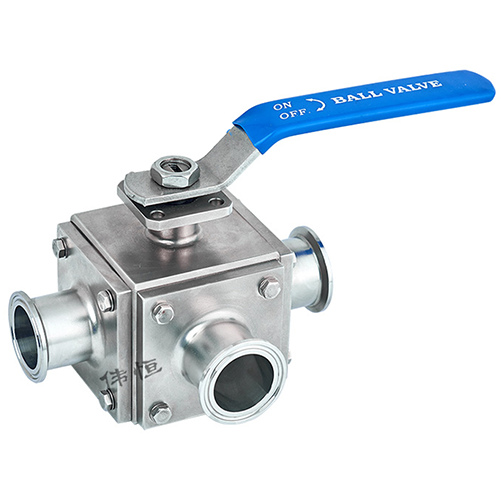
The Sanitary Square Three-Way Ball Valve is known for its exceptional performance and reliability in sanitary fluid control systems. Below are some of its key performance characteristics:
The three-way ball valve is designed to handle three different flow paths: straight-through flow, diverting flow, and mixing flow. This versatility makes it suitable for various fluid handling applications, from simple flow regulation to complex mixing and diversion.
The valve is constructed using materials that comply with the most stringent sanitary standards. It meets FDA, 3A, and EHEDG certifications, ensuring that it meets the hygiene requirements for industries such as food processing, pharmaceuticals, and biotechnology.
The stainless steel construction ensures the valve is resistant to corrosion, rust, and wear, even in harsh environments. Its ability to handle high pressures and temperatures makes it suitable for demanding processes in various industries.
The valve’s smooth surface finish and easy-to-disassemble design make it quick to clean and maintain. This reduces system downtime and ensures that the valve continues to perform at its best.
Below is a table summarizing the technical specifications of the Sanitary Square Three-Way Ball Valve to help you determine if it's the right fit for your system.
| Specification | Details |
|---|---|
| Material | Stainless Steel 304 or 316L |
| Connection Type | Flanged, Tri-Clamp, Threaded |
| Valve Type | Three-Way Ball Valve (L-port, T-port) |
| Pressure Rating | Up to 10 bar (145 psi) |
| Temperature Range | -10°C to 150°C (-14°F to 302°F) |
| Size Range | 1/2" to 4" (DN15 to DN100) |
| Seal Type | PTFE, EPDM, or food-grade elastomer |
| Flow Configuration | Diverting, Mixing, Straight-Through |
| Standards Complied | FDA, 3A, EHEDG, CE |
| Handle Type | Manual or Pneumatic |
L-Port: Used for straight-through flow or diverting flow in two directions.
T-Port: Used for mixing two different fluid streams into one flow.
To ensure optimal performance, it is essential to follow the proper operating procedures for the Sanitary Square Three-Way Ball Valve.
Before installation, ensure that the valve’s flow direction is aligned with your system’s flow requirements. The valve should be installed such that the flow markings match the desired flow path (straight-through, diversion, or mixing).
Ensure the system is depressurized before installation to prevent leakage and ensure safety.
Confirm that the correct valve size and type are selected for your system.
Flanged Connections: Attach the valve to the system using flanged connections. Tighten the bolts in a cross-pattern to ensure even pressure distribution and prevent leakage.
Tri-Clamp Connections: For hygienic applications, use Tri-Clamp connections for easy disassembly and cleaning.
Threaded Connections: Ensure the threads are properly sealed to avoid leakage.
The valve can be operated manually or pneumatically, depending on the handle type.
Manual Operation: Turn the valve handle to adjust the flow. The valve’s ball mechanism will either divert or mix the flow, depending on the configuration.
Pneumatic Operation: For automated systems, use a pneumatic actuator to control the valve remotely.
To ensure the Sanitary Square Three-Way Ball Valve performs to its full potential, it undergoes several testing procedures before delivery. These include:
The valve is subjected to hydrostatic testing to ensure it can withstand the rated pressure without any leakage.
Leakage testing is performed under standard conditions to check for any leakage around the seals or connections.
The valve is tested to ensure smooth and efficient operation of the ball mechanism and handle.
All flow paths (diverting, mixing, and straight-through) are tested to ensure they function as intended.
The valve’s internal and external surfaces are inspected to ensure that they meet the required sanitary standards for cleanliness and smoothness.
Any imperfections that could harbor bacteria or cause contamination are corrected before the valve is shipped.
Proper maintenance ensures the longevity and optimal performance of the Sanitary Square Three-Way Ball Valve. Below are the recommended maintenance steps:
Clean the valve using a CIP (Clean-In-Place) system for continuous sanitary processes.
If manual cleaning is needed, use non-abrasive cleaners and food-grade disinfectants.
Inspect the seals regularly for signs of wear, cracking, or degradation. Replace seals if they are damaged to prevent leakage.
If the valve is manual, lubricate the handle mechanism regularly to ensure smooth operation.
Daily or Weekly: Inspect the valve for any visible leaks, wear, or damage.
Annual Maintenance: Disassemble the valve for a complete inspection, and replace any worn-out components.
 RELATED
 RELATED
 RELATED
 RELATED
Tel: +86 577 8699 9257
Tel: +86 135 8786 5766 /+86 137 32079372
Email: wzweiheng@163.com
Address:No. 1633, Yidaoba Road, Binhai Industrial Park, Wenzhou City, Zhejiang Province

Scan wechat
This website uses cookies to ensure you get the best experience on our website.
 Español
 Portugues
 Pусский
 Français
 Deutsch
 한국어
한국어 العربية
 Italiano
 ไทย
ไทย Türk dili
 हिन्दी
 Melayu
 Tiếng Việt
 dansk
dansk қазақ
қазақ বাংলা
বাংলা українська
 Filipino
 o'zbek



 Phone
Phone