

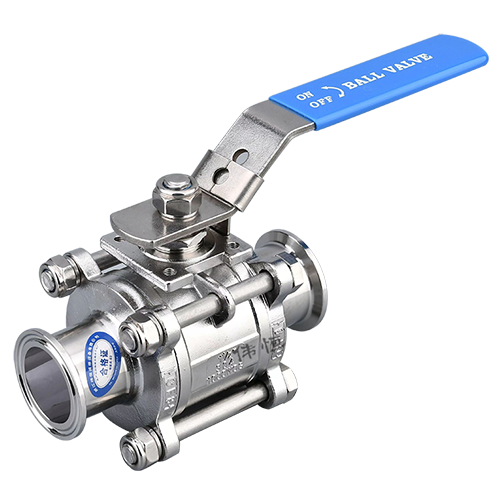
Sanitary three-piece quick-release ball valve is a type of valve widely used in food, pharmaceutical, bioengineering and other industries. It adopts a three-piece structure with a clamp connection, which makes it quick to assemble and disassemble, switch quickly and operate flexibly. The valve is mainly composed of a valve body, a spool and a seal, of which the valve body is made of acid-resistant stainless steel, and the seal is made of food-grade silicone rubber or Teflon, which meets food hygiene standards. In addition, its internal surface treatment meets the wall thickness standard of Ra0.4 and the outer surface finish reaches Ra0.6, which meets the relevant hygiene standards.
When using a sanitary three-piece quick-release ball valve, it is necessary to pay attention to not being subjected to strong impact during handling and installation to prevent the valve from deforming and resulting in poor sealing. The valve should be cleaned regularly during use to keep the valve clean and hygienic to prevent impurities in the medium from affecting the valve.
In short, the sanitary three-piece quick-release ball valve is a valve with simple structure, beautiful shape, quick assembly and disassembly, quick switching, flexible operation, low fluid resistance, safe and reliable use, and is widely used in many industries
It can be adapted to different installation needs, such as mounting accessories: pneumatic head (Pneumatic three-piece quick-release ball valve), handle (Manual three-piece quick-release ball valve), handwheel, electric head (electricActuator adjustmentThree-piece quick-release ball valve), actuators, electromagnetic actuators, filter actuators, regulators (Pneumatic actuator adjustmentThree-piece quick-release ball valve), explosion-proof actuators, signal actuators, etc
| name | Sanitary three-piece quick packBall valves |
| It is called the path | DN15-DN200mm |
| Nominal pressure | 1.6Mpa (If you need other pressure standards, please specify when ordering) |
| Connection | Quick assembly, clamps, quick cards, chucks |
| Body material | Carbon Steel (C) Stainless Steel 304 (P) Stainless Steel 316 (R) |
| Surface treatment | Mirror polishing inside and outside |
| Sealed material | Teflon (PTFE), EPDM, Silicone Rubber (VMQ), Butadiene Rubber (NBR), Fluorinated Rubber (FPM), Metal Seals (H), Carbide (Y) |
| Use the medium | Gas, liquid, oil, vacuum, water vapor |
| Medium temperature | -20℃-150℃(F) 、 -20℃-250℃ (PPL) 、-29℃-425℃(H)(Y) |
| apply | This type of ball valve series is a hygienic type of valve series for material transfer control. It is widely used in food and beverage processing, as well as in the pharmaceutical and chemical industries |
| standard | DIN standard series, 3A standard series SMS standard series, ISO/IDF standard series, BS/RJT standard series, ASME/BPE, etc. (There are various standard valve series that can be provided to customers) |
| The components of ball valves generally include: | A handle, a ball with a through cavity, valve body, valve core and shaft seal |
Remark:
The body of the sanitary straight-through quick-loading ball valve can adopt: casting or forging process;
The forms are divided into: floating, fixed, and top-mounted;
Sealing is divided into: soft seal and hard seal;
Withstand pressure up to: 2000 lbs, temperature resistance down to -196C up to 570.
Other special sealing materials or special temperatures can also be designed and selected according to customer requirements.
| Model representation method | ||||||||||||
| WH | -600 | —Q1 | —C1 | —F | —16 | —P | —25 | —D1 | —B | —W2 | —B2 | —L |
| >1. Weiheng brand | >2. Drive mode | >3. Valve body type | >4. Connection method | >5. Sealing material | >6. Nominal pressure | >7. Valve body material | >8. Nominal diameter | >9. Control mode | >10. Explosion-proof level | —20~150℃ | >12. Accessory options | >13. Three flows |
| 1~7 mandatory options, 8~13 optional | ||||||||||||
| 1 codename | 5 codename | Sealed material | 10 code | Explosion-proof rating | |
| WH | Weiheng brand | F | PTFE | B | ExdIl BT4 Gb explosionproof and explosion-proof type |
| PPL | Para-polyphenylene | BZ | ExdllCT5 Gb explosion-proof and explosion-proof type | ||
| 2 codename | Drive mode | H | Metal hard seal | BC | Exdll CT6 Gb explosionproof and explosion-proof type |
| 600 | Pneumatic actuator series | Y | cemented carbide | BM | ExmbllT4 Gb cast explosion-proof type |
| 900 | Electric actuator system | X1 | Ding Qing rubber NBR | BA | Exiall CT6Ga intrinsically safe and explosion-proof |
| 2001 | Column plastic actuator angle seat valve series | X2 | Natural rubber NR | ||
| 2002 | Stainless steel actuator angle seat valve series | X3 | EPDM | 11 codenames | Medium temperature |
| X4 | Viton rubber FPM | W1 | -20-80C | ||
| 3 codename | Body type | X5 | Food grade silicone rubber SI | W2 | -20-150C |
| Q1 | Two-way valve | F46 | Fully lined polyperfluoroethylene FEP | W3 | -20-250C |
| Q2 | Three-way valve | PFA | Fully lined with soluble PTFE PFA | W4 | -29-425C |
| Q3 | Four-way valve | F4 | Fully lined PTFE | W5 | -29-650C |
| Q4 | Stationary ball valve | N | nylon | W6 | -196-60C |
| Q5 | V-ball | TC | Lined ceramic | ...... | ...... |
| Q6 | Low profile ball valve | J | Rubber lining | It has a special temperature that can be designed and manufactured according to customer requirements | |
| Q7 | Sanitary grade ball valves | PEEK | Polyether ether ketone | ||
| Q8 | Plastic ball valves | W | When the ring | 12 codenames | Accessory selection |
| Q9 | High Vacuum Ball Valve | ...... | ...... | B1 | 2-position, 3-way solenoid valve |
| Q10 | Fluorine ball valve in the whole village | Other special sealing materials can be designed and manufactured according to customer requirements | B2 | 2-position 5-way solenoid valve | |
| Q11 | Cryogenic ball valves | B3 | 2-position 3-way explosion-proof solenoid valve | ||
| Q12 | Insulated ball valve | 6 codename | Nominal pressure | B4 | 2-position 5-way explosion-proof solenoid valve |
| Q13 | Eccentric hemispherical valve | ...... | ...... | B5 | Filter pressure reducing valve |
| Q14 | Tank bottom valve | B6 | Limit switch | ||
| Q15 | Ceramic ball valves | 7 codename | Body material | B7 | Explosion-proof limit switch |
| D1 | Centerline soft-sealed butterfly valve | Q | Ductile iron HT200 | B8 | Hand manipulation mechanism |
| D2 | 3. Eccentric butterfly valve | C | carbon steel | B9 | Locator |
| D3 | Sanitary Butterfly Valve | P | Stainless steel 304 | ...... | ...... |
| D4 | Plastic butterfly valve | R | Stainless steel 316 | ||
| D5 | Ventilation butterfly valve | PL | Stainless steel 304L | 13 codenames | Three flows |
| D6 | Fluorine butterfly valve in the whole village | RL | Stainless steel 316L | L | Tee L-type BC switching |
| D7 | High vacuum butterfly valve | U | PVC UPVC | T1 | Tee T-type C-port switch |
| D8 | Powder butterfly valve | PP | Reinforced polypropylene RPP | T2 | Tee T-type AB switching |
| Z1 | Gate valve | L | Aluminum alloy | T3 | Tee T-type AC switching |
| Z2 | Knife gate valve | ...... | ...... | T4 | Tee T-type B-port switch |
| J1 | Globe valve | Other special valve body materials can be designed and manufactured according to customer requirements | |||
| J2 | Bellows cut stop valve | ||||
| J3 | Angle seat valve | 8 codename | It is called the path | ||
| F1 | Upward expansion discharge valve | ...... | ...... | ||
| F2 | Downward discharge valve | ||||
| Other special valve body materials can be designed and manufactured according to customer requirements | 9 code | Control mode | |||
| Z | Standard switch type | ||||
| 4 codenames | Connection | T1 | Integral switching type | ||
| C1 | Female thread | T2 | Overall adjustment | ||
| C2 | By order | T3 | RS485 bus type | ||
| C3 | Male thread | D1 | Double acting | ||
| C4 | flange | D2 | Double-acting adjustment type | ||
| C5 | KF vacuum chuck | E1 | Uni-acting normally closed | ||
| C6 | weld | E2 | Single-acting normally closed regulation type | ||
| C7 | Pair clip | E3 | Single-acting and always open | ||
| C8 | Clamps | E4 | Single-acting normally open adjustment type | ||
Sanitary Three-Piece Quick-Release Ball Valve
The sanitary three-piece quick-release ball valve is a high-performance hygienic valve specifically designed for industries that require strict cleanliness, fast maintenance, and stable flow control. Commonly used in food, beverage, dairy, pharmaceutical, cosmetic, biotechnology, and high-purity water applications, this valve features a unique three-piece clamp-connected body that supports rapid disassembly without tools. Its sanitary design ensures smooth fluid transfer, minimal contamination risk, and excellent cleanability.
Manufactured from premium stainless steel such as SS304 or SS316L, the valve is engineered to withstand demanding operating environments. The full-bore construction minimizes pressure loss, while the polished interior surface prevents residue accumulation and supports CIP (Clean-in-Place) and SIP (Sterilization-in-Place) procedures. Whether used in an automated production line or as part of a manual flow control system, the sanitary quick-release ball valve delivers reliable performance, easy operation, and long service life.
2. Product Highlights
The sanitary three-piece quick-release ball valve stands out due to its hygienic structure, durable materials, and maintenance-friendly design. Below are the core product highlights:
The valve consists of:
A central body
Two end caps
High-quality tri-clamp or quick-release connectors
This design allows quick removal of the center body for inspection, cleaning, or replacement—without disrupting the entire pipeline.
Tri-clamp or quick-release connections provide:
Tool-free assembly
Minimal downtime
Easy integration into sanitary pipeline systems
This feature significantly reduces labor costs and simplifies maintenance procedures in production facilities.
The interior is mechanically polished to Ra ≤ 0.8 μm or better, ensuring:
Smooth flow
Reduced risk of bacterial growth
Easy CIP/SIP cleaning
The smooth finish is ideal for food, pharmaceutical, and cosmetic-grade process lines.
The full-bore design:
Minimizes pressure drop
Prevents clogging
Allows high-volume flow
This makes the valve suitable for viscous liquids, slurries, and other demanding sanitary applications.
Made from forged SS304 or SS316L:
Excellent corrosion resistance
High temperature resistance
Long-term durability in washdown environments
316L stainless steel improves performance in acidic or chloride-rich conditions.
The valve supports:
Pneumatic actuators
Electric actuators
Manual handles
This versatility makes it easy to integrate into fully automated production systems.
3. Technical Specifications
| Parameter | Specification |
|---|---|
| Valve Type | Sanitary three-piece quick-release ball valve |
| Material | SS304 / SS316L |
| Seat Material | PTFE / TFM / EPDM / PCTFE |
| Surface Finish | Ra ≤ 0.8 μm (sanitary polished) |
| Connection Type | Tri-clamp / quick-release clamp |
| Port Type | Full port |
| Sizes | 1/2" to 4" |
| Operating Pressure | Up to PN16–PN40 |
| Temperature Range | -20°C to 180°C |
| Operation | Manual / pneumatic / electric |
| Cleaning Compatibility | CIP & SIP |
| Certifications | CE, ISO 9001, FDA compliance |
4. Operation Procedures
Correct operation ensures performance stability, long service life, and hygienic integrity. Follow the steps below for safe and efficient use.
Before using the valve:
Verify correct size and clamp compatibility.
Confirm the cleaning cycle has been completed.
Ensure all clamps and gaskets are properly tightened.
Check for visible damage on the seat, ball, and body.
Make sure the valve is installed in the correct flow direction (if applicable).
Ensure that the pipeline is depressurized.
Pull or rotate the handle to the "Open" position.
Confirm the ball bore aligns with the pipeline.
Check for any unusual noise or vibration.
With actuators:
Pneumatic: Ensure adequate air supply and correct signal feedback.
Electric: Verify the motor control position before startup.
Gradually rotate the handle to avoid pressure shock.
Ensure the handle reaches the exact 0° closed position.
Monitor the pipeline for leaks or fluid bypass.
The valve supports in-line cleaning without disassembly:
CIP: Use alkaline or neutral detergents (60–80°C).
SIP: Steam sterilization (121°C to 135°C depending on gasket materials).
Regular cleaning removes:
Organic residues
Microbial contaminants
Chemical deposits
Depressurize and drain the pipeline.
Loosen the tri-clamp connections.
Remove the central body from the pipeline.
Inspect the ball, seat, and stem components.
Align the valve body with the end caps.
Insert new gaskets if necessary.
Secure the clamps evenly to ensure uniform sealing.
Perform a pressure test before returning to service.
5. Upgrade and Maintenance Plan
A well-organized maintenance plan ensures consistent performance and hygienic integrity over long-term use.
| Maintenance Task | Recommended Frequency |
|---|---|
| Visual valve inspection | Daily or before each shift |
| Clamp and gasket check | Weekly |
| Seat and ball inspection | Monthly |
| Full valve disassembly and cleaning | Every 2–3 months |
| Gasket replacement | 3–6 months based on usage |
| Stem seal replacement | Annually |
| Actuator maintenance (if applicable) | Every 6–12 months |
To maintain system efficiency:
Replace PTFE seats with TFM for higher temperature applications.
Upgrade manual handle valves to pneumatic actuators for automation.
Upgrade clamp gaskets to EPDM or FKM for improved chemical resistance.
Replace standard stainless steel with 316L for aggressive environments.
Ensure correct torque on all clamps.
Do not expose gaskets to extreme temperatures beyond the rating.
Avoid abrasive or solid-laden media that may damage the seat.
Use only manufacturer-approved replacement parts.
6. Technical Service Support
A reliable after-sales and technical service program ensures stable operation and minimal downtime.
Valve selection guidance based on pipeline conditions
On-site or remote installation assistance
Recommendations for gasket and clamp compatibility
Professional cleaning and re-polishing
Seat and gasket replacement
Stem and ball component repair
Actuator troubleshooting
Customers receive access to:
Pressure test reports
Material certificates (EN10204 3.1)
CAD drawings and 3D models
Operation & maintenance manuals
CIP/SIP cycle recommendations
The valve can be customized with:
Special clamp sizes
Custom markings or laser engraving
High-temperature materials
Extended handles
Locking devices
ISO mounting pads for automation
7. Troubleshooting Guide
A fast troubleshooting process minimizes production interruptions.
| Issue | Cause | Solution |
|---|---|---|
| Leakage at clamp | Loose clamp or damaged gasket | Tighten clamp; replace gasket |
| Internal leakage | Worn seat or damaged ball | Replace seat; polish or replace ball |
| Handle hard to turn | Contamination or dry stem | Clean valve; lubricate stem with food-grade grease |
| Vibration | High flow velocity | Reduce flow rate or stabilize pipeline |
| Actuator not responding | Air pressure or wiring issue | Check air supply/electrical connections |
8. Application Fields
This valve is engineered for a wide range of sanitary and hygienic industries:
Sauce production
Fruit juice processing
Beer and brewery systems
Dairy milk pipelines
Water-for-injection systems
Fermentation reactors
Pipelines requiring sterile control
Creams and lotions
Essential oils
Liquid soaps and detergents
Cell culture systems
Sterile transfer lines
RO/UF water treatment
Distribution loops
9. Why Choose Sanitary Three-Piece Quick-Release Ball Valves?
Customers choose this valve because it offers:
Rapid disassembly for fast cleaning
Hygienic polished surface preventing contamination
Full-bore flow with minimal pressure loss
Long service life due to corrosion-resistant steel
Compatibility with sanitary standards
Flexible operation (manual/pneumatic/electric)
Easy integration into existing hygienic pipeline systems
It is the ideal solution for facilities that require both sanitation and operational efficiency.
10. Conclusion
The sanitary three-piece quick-release ball valve is a highly efficient, hygienic, and maintenance-friendly valve solution for modern processing environments. With its tri-clamp connection, polished stainless-steel structure, and full-port flow design, it ensures superior cleanliness, stable operation, and effortless maintenance. Its flexibility in installation, compatibility with automated systems, and excellent durability make it a top choice for food, beverage, pharmaceutical, and cosmetic industries.
By implementing proper operation practices, upgrading critical components when necessary, and following routine maintenance schedules, facilities can ensure this valve provides long-term reliability and optimal performance. Supported by comprehensive technical services and customization options, the sanitary three-piece quick-release ball valve remains an essential component in high-demand hygienic fluid control systems.
 RELATED
Tel: +86 577 8699 9257
Tel: +86 135 8786 5766 /+86 137 32079372
Email: wzweiheng@163.com
Address:No. 1633, Yidaoba Road, Binhai Industrial Park, Wenzhou City, Zhejiang Province

Scan wechat
This website uses cookies to ensure you get the best experience on our website.
 Español
 Portugues
 Pусский
 Français
 Deutsch
 한국어
한국어 العربية
 Italiano
 ไทย
ไทย Türk dili
 हिन्दी
 Melayu
 Tiếng Việt
 dansk
dansk қазақ
қазақ বাংলা
বাংলা українська
 Filipino
 o'zbek



 Phone
Phone