

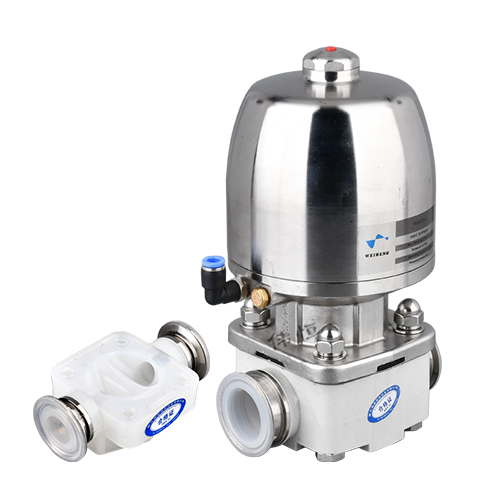
A stainless steel pneumatic head fluorine-lined diaphragm valve is a type of valve that is mainly composed of stainless steel and fluoroplastic (fluorine-lined). This valve has excellent corrosion resistance and good sealing performance, so it is widely used in pipeline systems in chemical, pharmaceutical, petroleum and other industries.
The working principle of a stainless steel pneumatic head fluorine-lined diaphragm valve is to use the diaphragm plate to move up and down in the valve body to control the on/off of the fluid. Due to the presence of fluorine-lined layer, the valve has good corrosion resistance and can effectively prevent the erosion of various chemical media. At the same time, due to the application of the pneumatic head, the valve can be controlled remotely, which is convenient for operation and management.
The advantages of stainless steel pneumatic head fluorine-lined diaphragm valves include:
A. Strong corrosion resistance: Due to the presence of a
fluorine-lined layer, the valve can resist the erosion of various
chemical media, thereby extending the service life of the valve.
B. Good sealing: The seal between the diaphragm and the valve body is a combination of metal and fluoroplastic, which has good sealing performance and can effectively prevent leakage.
C. Easy to operate: The valve can be controlled remotely through the
pneumatic head, which is convenient for operation and management.
D. Wide range of applications: Due to its excellent corrosion
resistance and sealing properties, stainless steel pneumatic head
fluorine diaphragm valves are widely used in various industries and
fields.
The stainless steel pneumatic head fluorine-lined diaphragm valve is a high-performance valve with excellent corrosion resistance and sealing properties, which can meet the fluid control needs in various complex environments.
Technical Scope
Temperature range: 0°C~150°C.
Working pressure: vacuum ~16Mpa (20°C)
Applicable fluids: can convey extremely strong chemically corrosive media, can withstand high temperature, vacuum resistance, wear resistance, and can be anti-static.
Application field: used in injections, vaccines, food hygiene, beverages, pharmaceuticals, chemical chemicals, biology, lithium batteries, semiconductor engineering and other industries.
Compliant with standards: Meets FDA and USP certifications.
Fluorine-lined valves, also known as fluoroplastic-lined
corrosion-resistant valves, are made of PTFE or PFA (or profiles
processed) by molding (or inlaying) on the inner wall of steel or iron
valve pressure bearings (the same method is applicable to the lining of
various pressure vessels and pipeline accessories) or the outer surface
of valve linings, and using its unique properties in strong corrosion
resistance media to make various valves and pressure vessels.
Fluorine-lined valves can use lining process for all the places that can be reached by the medium in the valve body, and the lining materials are generally made of fluoroplastics such as FEP (F46) and PCTFE (F3), which can be applied to various concentrations of sulfuric acid, hydrochloric acid, hydrofluoric acid, aqua regia and various organic acids, strong acids, strong oxidants and other corrosive media and other pipelines. However, fluorine-lined valves are limited by temperature, only suitable for mediums between -50°C~150°C, please consult our customer service for details.
Valves that can be made lined with fluorine plastics include: fluorine-lined butterfly valves,Fluorine-lined ball valves, fluorine-lined globe valve,Fluorine-lined diaphragm valves, fluorine-lined gate valves, fluorine-lined plug valves,Fluorine-lined pipe fittings、Fluorine-lined jointsetc., and accessories include (electric, pneumatic, electromagnetic, explosion-proof, filtering, adjustment, remote automatic control and other functions).
| Properties of PTFE-polytetrafluoroethylene | |
| High temperature resistance | The operating temperature is up to 250°C |
| Resistant to low temperatures | It has good mechanical toughness and maintains an elongation of 5% even when the temperature drops to -196°C |
| It is non-toxic | It has physiological inertness and has no adverse reactions as artificial blood vessels and organs implanted in the body for a long time |
| Mechanical properties | It is the smallest surface tension in solid materials, does not adhere to any substance, and its friction coefficient is extremely small, only 1/5 of polyethylene, which is an important feature of perfluorocarbon surfaces. Because the intermolecular force of the fluorocarbon-carbon chain is extremely low, PTFE is non-stick |
| Excellent insulation performance | A thick layer of newspaper film is enough to resist 1500V high voltage, |
| Chemical and weather resistance | Teflon is virtually immune to any chemical agents except molten alkali metals. For example, when boiled in concentrated sulfuric acid, nitric acid, hydrochloric acid, or even aqua regia, its weight and properties do not change, and it is almost insoluble in all solvents, and is only slightly soluble in perankanes (about 0.1g/100g) above 300°C. |
| Excellent weather resistance | It does not absorb moisture, is non-combustible, is extremely stable to oxygen and ultraviolet rays, and has the best aging life among plastics |
| Electrical performance | Teflon has low dielectric constant and dielectric loss over a wide frequency range, as well as high breakdown voltage, volumetric resistivity, and arc resistance |
| Model representation method | ||||||||||||
| WH | -600 | —Q1 | —C1 | —F | —16 | —P | —25 | —D1 | —B | —W2 | —B2 | —L |
| >1. Weiheng brand | >2. Drive mode | >3. Valve body type | >4. Connection method | >5. Sealing material | >6. Nominal pressure | >7. Valve body material | >8. Nominal diameter | >9. Control mode | >10. Explosion-proof level | —20~150℃ | >12. Accessory options | >13. Three flows |
| 1~7 mandatory options, 8~13 optional | ||||||||||||
| 1 codename | 5 codename | Sealed material | 10 code | Explosion-proof rating | |
| WH | Weiheng brand | F | PTFE | B | ExdIl BT4 Gb explosionproof and explosion-proof type |
| PPL | Para-polyphenylene | BZ | ExdllCT5 Gb explosion-proof and explosion-proof type | ||
| 2 codename | Drive mode | H | Metal hard seal | BC | Exdll CT6 Gb explosionproof and explosion-proof type |
| 600 | Pneumatic actuator series | Y | cemented carbide | BM | ExmbllT4 Gb cast explosion-proof type |
| 900 | Electric actuator system | X1 | Ding Qing rubber NBR | BA | Exiall CT6Ga intrinsically safe and explosion-proof |
| 2001 | Column plastic actuator angle seat valve series | X2 | Natural rubber NR | ||
| 2002 | Stainless steel actuator angle seat valve series | X3 | EPDM | 11 codenames | Medium temperature |
| X4 | Viton rubber FPM | W1 | -20-80C | ||
| 3 codename | Body type | X5 | Food grade silicone rubber SI | W2 | -20-150C |
| Q1 | Two-way valve | F46 | Fully lined polyperfluoroethylene FEP | W3 | -20-250C |
| Q2 | Three-way valve | PFA | Fully lined with soluble PTFE PFA | W4 | -29-425C |
| Q3 | Four-way valve | F4 | Fully lined PTFE | W5 | -29-650C |
| Q4 | Stationary ball valve | N | nylon | W6 | -196-60C |
| Q5 | V-ball | TC | Lined ceramic | ...... | ...... |
| Q6 | Low profile ball valve | J | Rubber lining | It has a special temperature that can be designed and manufactured according to customer requirements | |
| Q7 | Sanitary grade ball valves | PEEK | Polyether ether ketone | ||
| Q8 | Plastic ball valves | W | When the ring | 12 codenames | Accessory selection |
| Q9 | High Vacuum Ball Valve | ...... | ...... | B1 | 2-position, 3-way solenoid valve |
| Q10 | Fluorine ball valve in the whole village | Other special sealing materials can be designed and manufactured according to customer requirements | B2 | 2-position 5-way solenoid valve | |
| Q11 | Cryogenic ball valves | B3 | 2-position 3-way explosion-proof solenoid valve | ||
| Q12 | Insulated ball valve | 6 codename | Nominal pressure | B4 | 2-position 5-way explosion-proof solenoid valve |
| Q13 | Eccentric hemispherical valve | ...... | ...... | B5 | Filter pressure reducing valve |
| Q14 | Tank bottom valve | B6 | Limit switch | ||
| Q15 | Ceramic ball valves | 7 codename | Body material | B7 | Explosion-proof limit switch |
| D1 | Centerline soft-sealed butterfly valve | Q | Ductile iron HT200 | B8 | Hand manipulation mechanism |
| D2 | 3. Eccentric butterfly valve | C | carbon steel | B9 | Locator |
| D3 | Sanitary Butterfly Valve | P | Stainless steel 304 | ...... | ...... |
| D4 | Plastic butterfly valve | R | Stainless steel 316 | ||
| D5 | Ventilation butterfly valve | PL | Stainless steel 304L | 13 codenames | Three flows |
| D6 | Fluorine butterfly valve in the whole village | RL | Stainless steel 316L | L | Tee L-type BC switching |
| D7 | High vacuum butterfly valve | U | PVC UPVC | T1 | Tee T-type C-port switch |
| D8 | Powder butterfly valve | PP | Reinforced polypropylene RPP | T2 | Tee T-type AB switching |
| Z1 | Gate valve | L | Aluminum alloy | T3 | Tee T-type AC switching |
| Z2 | Knife gate valve | ...... | ...... | T4 | Tee T-type B-port switch |
| J1 | Globe valve | Other special valve body materials can be designed and manufactured according to customer requirements | |||
| J2 | Bellows cut stop valve | ||||
| J3 | Angle seat valve | 8 codename | It is called the path | ||
| F1 | Upward expansion discharge valve | ...... | ...... | ||
| F2 | Downward discharge valve | ||||
| Other special valve body materials can be designed and manufactured according to customer requirements | 9 code | Control mode | |||
| Z | Standard switch type | ||||
| 4 codenames | Connection | T1 | Integral switching type | ||
| C1 | Female thread | T2 | Overall adjustment | ||
| C2 | By order | T3 | RS485 bus type | ||
| C3 | Male thread | D1 | Double acting | ||
| C4 | flange | D2 | Double-acting adjustment type | ||
| C5 | KF vacuum chuck | E1 | Uni-acting normally closed | ||
| C6 | weld | E2 | Single-acting normally closed regulation type | ||
| C7 | Pair clip | E3 | Single-acting and always open | ||
| C8 | Clamps | E4 | Single-acting normally open adjustment type | ||
Stainless Steel Pneumatic Head Fluorine-Lined Diaphragm Valve: A Comprehensive Guide
The Stainless Steel Pneumatic Head Fluorine-Lined Diaphragm Valve is a high-performance valve designed for fluid and gas control in industries where chemical resistance, durability, and precision are critical. Featuring a stainless steel body and fluorine lining (e.g., PTFE or PFA), this valve offers exceptional protection against corrosive fluids and gases. The pneumatic head enables fast, reliable, and automated actuation, making it ideal for applications in industries like chemical processing, pharmaceuticals, water treatment, and food processing.
This article provides a comprehensive overview of the maintenance, safety instructions, precautions, and performance testing of the Stainless Steel Pneumatic Head Fluorine-Lined Diaphragm Valve. By following these guidelines, operators can ensure the longevity and efficiency of the valve, minimizing downtime and operational costs.
The stainless steel body of the valve provides high strength, durability, and resistance to wear and tear. It is ideal for harsh operating environments and ensures long-term performance.
The fluorine lining (PTFE or PFA) provides excellent resistance to a wide range of corrosive chemicals, acids, solvents, and aggressive fluids. This makes the valve suitable for use in industries dealing with harsh substances, where traditional valves might fail.
The pneumatic head offers precise, fast, and reliable actuation, making it ideal for automated systems that require quick response times and minimal downtime. The actuator is powered by compressed air, reducing energy costs compared to electric actuation systems.
The diaphragm design ensures a leak-tight seal, preventing contamination and ensuring the safety and cleanliness of the system. This design is especially beneficial in systems that require contamination-free operation, such as in pharmaceutical or food processing.
The valve is suitable for a wide range of industries, including chemical processing, water treatment, pharmaceuticals, food and beverage, and mining, offering both flexibility and reliability in diverse operational conditions.
| Specification | Value |
|---|---|
| Valve Type | Pneumatic Diaphragm Valve |
| Body Material | Stainless Steel |
| Lining Material | Fluoropolymer (PTFE, PFA) |
| Actuation Type | Pneumatic |
| Pressure Range | 0.5 to 16 MPa |
| Temperature Range | -20°C to 150°C |
| Size Range | 1 inch to 8 inches |
| Flow Control | On/Off or Modulating |
| End Connection Type | Flanged, Threaded |
| Seal Type | Diaphragm |
| Application | Chemical Processing, Pharmaceuticals, Food Processing |
| Service Life | 5 to 10 years (depending on usage) |
Regular inspection of the Stainless Steel Pneumatic Head Fluorine-Lined Diaphragm Valve ensures that it continues to operate effectively and efficiently. Inspections should be conducted every 6 to 12 months, depending on the operating environment and frequency of use.
Visual Inspection: Check the valve body and diaphragm for any signs of wear, corrosion, or damage. Look for any chemical buildup on the valve's surface.
Diaphragm Check: Ensure that the diaphragm is intact, free from cracks or pinholes, and properly aligned with the valve body.
Pneumatic Actuator: Verify that the pneumatic actuator is functioning correctly. Check for air leaks, and ensure the actuator moves freely without obstruction.
Connections: Ensure that the valve's connections (flanged or threaded) are secure and free of leaks.
To ensure the valve continues to operate smoothly, it is essential to clean it regularly to remove buildup and debris.
External Cleaning: Use a soft cloth and mild detergent to clean the valve body and external components. Avoid using abrasive materials that may scratch or damage the fluorine lining.
Internal Cleaning: For valves handling corrosive fluids, flush the valve with compatible cleaning agents or solvents to remove residue and prevent clogging.
Pneumatic Actuator Cleaning: Clean the actuator's air inlet to remove any dust or debris that could affect its operation.
Lubrication of the valve’s moving parts, including the pneumatic actuator and diaphragm mechanism, is essential for smooth operation. Use a lubricant compatible with the valve's materials and operating environment.
Apply lubricant to the actuator’s moving parts.
Lubricate the diaphragm and valve stem as needed, but avoid over-lubricating, as excess lubricant can attract dust and debris.
Over time, seals and the diaphragm may degrade due to chemical exposure, temperature fluctuations, or mechanical stress. Replacing these components at regular intervals or when wear is detected will prevent leaks and maintain the valve’s performance.
When handling the Stainless Steel Pneumatic Head Fluorine-Lined Diaphragm Valve, always wear appropriate PPE, including gloves, safety goggles, and protective clothing. This is especially important when the valve is in contact with corrosive chemicals or hot fluids.
Ensure the valve operates within the specified pressure and temperature ranges. Over-pressurization or exposure to excessive temperatures can damage the valve and lead to failures.
Always verify system pressure before adjusting or maintaining the valve.
If the valve is used in systems carrying hazardous or corrosive fluids, make sure that the area is well-ventilated. Use proper containment systems to prevent accidental spills or leaks. Always follow your company’s safety protocols when handling hazardous materials.
Before performing maintenance, always follow lockout/tagout procedures to ensure that the system is fully shut off and depressurized. This will prevent accidental activation of the valve during maintenance activities.
Avoid using harsh or abrasive cleaning agents, as these can damage the fluorine lining of the valve, compromising its resistance to corrosion.
When handling or replacing the diaphragm or seals, make sure the work environment is clean to prevent contamination. Foreign particles or debris can interfere with the valve’s sealing capability and lead to leakage.
When installing or replacing the valve, avoid over-tightening the connections. Over-tightening can cause stress on the valve body and lead to cracking or distortion, which could compromise the seal.
Perform routine functional testing to ensure the valve operates smoothly and responds correctly to pneumatic signals. Any abnormalities should be addressed immediately to prevent larger system failures.
To ensure the valve is working correctly, perform a functional test by opening and closing the valve multiple times. The valve should open and close smoothly without resistance or delay. If the valve does not respond properly, inspect the actuator and diaphragm for wear or damage.
A pressure test should be conducted periodically to ensure that the valve can handle the operating pressure without leakage. Perform both hydrostatic and pneumatic pressure tests to ensure the integrity of the valve.
Hydrostatic Testing: Fill the valve body with water and pressurize it to the recommended maximum pressure. Inspect for leaks around the valve body, diaphragm, and connections.
Pneumatic Testing: Use compressed air to test the valve's sealing and actuation capabilities. Listen for any air leaks around the actuator or valve seat.
Check for any leaks at the valve’s seat, actuator, and connections. Use a non-invasive leak detection method, such as ultrasonic leak detectors or bubble solutions, to pinpoint any leaks.
The Stainless Steel Pneumatic Head Fluorine-Lined Diaphragm Valve comes with a 2-year warranty from the date of purchase. This warranty covers defects in materials or workmanship under normal operating conditions.
Our technical support team is available for consultations, troubleshooting, and installation guidance. We also provide remote diagnostics for system issues, ensuring minimal downtime.
We offer genuine replacement parts, including diaphragms, seals, and actuators, to ensure the long-term performance of your valve.
We provide preventive maintenance services to help extend the life of the valve, reduce breakdowns, and keep it functioning optimally.
The Stainless Steel Pneumatic Head Fluorine-Lined Diaphragm Valve is a robust and reliable solution for fluid control in aggressive and corrosive environments. By following proper maintenance, safety protocols, and performance testing, businesses can ensure the valve's efficiency, longevity, and safety. With our after-sales support and warranty, you can have peace of mind knowing that your investment is protected.
Tel: +86 577 8699 9257
Tel: +86 135 8786 5766 /+86 137 32079372
Email: wzweiheng@163.com
Address:No. 1633, Yidaoba Road, Binhai Industrial Park, Wenzhou City, Zhejiang Province

Scan wechat
This website uses cookies to ensure you get the best experience on our website.
 Español
 Portugues
 Pусский
 Français
 Deutsch
 한국어
한국어 العربية
 Italiano
 ไทย
ไทย Türk dili
 हिन्दी
 Melayu
 Tiếng Việt
 dansk
dansk қазақ
қазақ বাংলা
বাংলা українська
 Filipino
 o'zbek



 Phone
Phone