

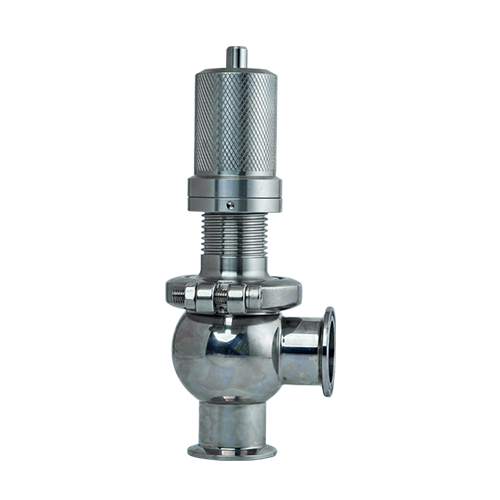
Sanitary pneumatic screw reversing valve is a special pneumatic control valve that meets sanitary standards. It adopts a screw structure, which has the characteristics of high adjustment accuracy, good stability and high reliability, and meets sanitary standards, which can meet the special requirements of pharmaceutical, food, chemical and other industries.
The design and manufacture of sanitary pneumatic screw regulating reversing valves need to meet strict hygiene standards to ensure that they do not cause contamination to the media during use. It is typically made of corrosion-resistant and easy-to-clean materials such as stainless steel or high-strength engineering plastics, making it suitable for various harsh industrial environments.
Compared with ordinary pneumatic control valves, sanitary pneumatic screw regulating reversing valves offer higher reliability and longer service life. It is capable of accurately controlling the flow and direction of gases, and is characterized by fast response and stability, and can adapt to various complex pneumatic control systems.
Sanitary pneumatic screw regulating reversing valves have a wide range of applications, mainly suitable for occasions that require high precision, high reliability, and strict hygiene requirements, such as pharmaceuticals, food, chemical industry, bioengineering and other fields. It can be used with various sanitary-grade pneumatic actuators to achieve automated control and improve production efficiency and product quality.
Sanitary pneumatic screw regulating reversing valve is an efficient and accurate pneumatic control element that meets sanitary standards, which can meet the special requirements of pharmaceutical, food, chemical and other industries, and provide strong support for the development of industrial automation.
| Model representation method | ||||||||||||
| WH | -600 | —Q1 | —C1 | —F | —16 | —P | —25 | —D1 | —B | —W2 | —B2 | —L |
| >1. Weiheng brand | >2. Drive mode | >3. Valve body type | >4. Connection method | >5. Sealing material | >6. Nominal pressure | >7. Valve body material | >8. Nominal diameter | >9. Control mode | >10. Explosion-proof level | —20~150℃ | >12. Accessory options | >13. Three flows |
| 1~7 mandatory options, 8~13 optional | ||||||||||||
| 1 codename | 5 codename | Sealed material | 10 code | Explosion-proof rating | |
| WH | Weiheng brand | F | PTFE | B | ExdIl BT4 Gb explosionproof and explosion-proof type |
| PPL | Para-polyphenylene | BZ | ExdllCT5 Gb explosion-proof and explosion-proof type | ||
| 2 codename | Drive mode | H | Metal hard seal | BC | Exdll CT6 Gb explosionproof and explosion-proof type |
| 600 | Pneumatic actuator series | Y | cemented carbide | BM | ExmbllT4 Gb cast explosion-proof type |
| 900 | Electric actuator system | X1 | Ding Qing rubber NBR | BA | Exiall CT6Ga intrinsically safe and explosion-proof |
| 2001 | Column plastic actuator angle seat valve series | X2 | Natural rubber NR | ||
| 2002 | Stainless steel actuator angle seat valve series | X3 | EPDM | 11 codenames | Medium temperature |
| X4 | Viton rubber FPM | W1 | -20-80C | ||
| 3 codename | Body type | X5 | Food grade silicone rubber SI | W2 | -20-150C |
| Q1 | Two-way valve | F46 | Fully lined polyperfluoroethylene FEP | W3 | -20-250C |
| Q2 | Three-way valve | PFA | Fully lined with soluble PTFE PFA | W4 | -29-425C |
| Q3 | Four-way valve | F4 | Fully lined PTFE | W5 | -29-650C |
| Q4 | Stationary ball valve | N | nylon | W6 | -196-60C |
| Q5 | V-ball | TC | Lined ceramic | ...... | ...... |
| Q6 | Low profile ball valve | J | Rubber lining | It has a special temperature that can be designed and manufactured according to customer requirements | |
| Q7 | Sanitary grade ball valves | PEEK | Polyether ether ketone | ||
| Q8 | Plastic ball valves | W | When the ring | 12 codenames | Accessory selection |
| Q9 | High Vacuum Ball Valve | ...... | ...... | B1 | 2-position, 3-way solenoid valve |
| Q10 | Fluorine ball valve in the whole village | Other special sealing materials can be designed and manufactured according to customer requirements | B2 | 2-position 5-way solenoid valve | |
| Q11 | Cryogenic ball valves | B3 | 2-position 3-way explosion-proof solenoid valve | ||
| Q12 | Insulated ball valve | 6 codename | Nominal pressure | B4 | 2-position 5-way explosion-proof solenoid valve |
| Q13 | Eccentric hemispherical valve | ...... | ...... | B5 | Filter pressure reducing valve |
| Q14 | Tank bottom valve | B6 | Limit switch | ||
| Q15 | Ceramic ball valves | 7 codename | Body material | B7 | Explosion-proof limit switch |
| D1 | Centerline soft-sealed butterfly valve | Q | Ductile iron HT200 | B8 | Hand manipulation mechanism |
| D2 | 3. Eccentric butterfly valve | C | carbon steel | B9 | Locator |
| D3 | Sanitary Butterfly Valve | P | Stainless steel 304 | ...... | ...... |
| D4 | Plastic butterfly valve | R | Stainless steel 316 | ||
| D5 | Ventilation butterfly valve | PL | Stainless steel 304L | 13 codenames | Three flows |
| D6 | Fluorine butterfly valve in the whole village | RL | Stainless steel 316L | L | Tee L-type BC switching |
| D7 | High vacuum butterfly valve | U | PVC UPVC | T1 | Tee T-type C-port switch |
| D8 | Powder butterfly valve | PP | Reinforced polypropylene RPP | T2 | Tee T-type AB switching |
| Z1 | Gate valve | L | Aluminum alloy | T3 | Tee T-type AC switching |
| Z2 | Knife gate valve | ...... | ...... | T4 | Tee T-type B-port switch |
| J1 | Globe valve | Other special valve body materials can be designed and manufactured according to customer requirements | |||
| J2 | Bellows cut stop valve | ||||
| J3 | Angle seat valve | 8 codename | It is called the path | ||
| F1 | Upward expansion discharge valve | ...... | ...... | ||
| F2 | Downward discharge valve | ||||
| Other special valve body materials can be designed and manufactured according to customer requirements | 9 code | Control mode | |||
| Z | Standard switch type | ||||
| 4 codenames | Connection | T1 | Integral switching type | ||
| C1 | Female thread | T2 | Overall adjustment | ||
| C2 | By order | T3 | RS485 bus type | ||
| C3 | Male thread | D1 | Double acting | ||
| C4 | flange | D2 | Double-acting adjustment type | ||
| C5 | KF vacuum chuck | E1 | Uni-acting normally closed | ||
| C6 | weld | E2 | Single-acting normally closed regulation type | ||
| C7 | Pair clip | E3 | Single-acting and always open | ||
| C8 | Clamps | E4 | Single-acting normally open adjustment type | ||
Pneumatic Screw Regulating Reversing Valve
The Pneumatic Screw Regulating Reversing Valve is an essential component in pneumatic control systems. Designed to provide precise directional control over airflow, this valve allows users to switch fluid direction efficiently and effectively. It is ideal for use in automated machinery, actuator control systems, and various industrial applications that require reliable switching between two flow directions.
Featuring a screw-regulating mechanism, this valve enables easy manual adjustments to regulate flow, enhancing flexibility and control. The valve is built for high-performance in high-pressure, high-temperature environments, and is designed with durable materials to ensure long-term reliability and minimal maintenance.
In this article, we will discuss the operational recommendations, maintenance techniques, energy-saving benefits, and warranty policies of the Pneumatic Screw Regulating Reversing Valve. Whether you're installing it in a new system or maintaining an existing one, this guide will provide you with the knowledge to maximize its performance and lifespan.
The screw-regulating mechanism provides fine-tuned flow control and adjustable direction switching, offering precise regulation of airflow for your pneumatic system.
It enables quick and reliable direction changes, improving system efficiency and flexibility in dynamic operations.
Constructed with high-quality materials such as stainless steel, the valve is designed to withstand high-pressure and high-temperature applications.
Corrosion-resistant seals and robust body ensure long-lasting durability, even in challenging industrial environments.
Pneumatic operation requires significantly less energy compared to electric or hydraulic alternatives, providing a cost-effective solution for long-term operations.
The valve’s design ensures minimal air leakage and optimized air consumption, improving overall system energy efficiency.
The screw-regulating feature makes it easy to adjust the valve’s flow characteristics manually, making it ideal for applications where precise flow regulation is critical.
The compact design and quick-installation feature reduce the overall setup time, making it suitable for both new installations and system upgrades.
Below is a table outlining the key technical parameters for the Pneumatic Screw Regulating Reversing Valve:
| Specification | Details |
|---|---|
| Valve Type | Pneumatic Screw Regulating Reversing Valve |
| Body Material | Stainless Steel, Cast Iron |
| Seal Material | PTFE, NBR, Viton |
| Pressure Rating | 0-40 bar (PN40) |
| Temperature Range | -10°C to 150°C |
| Flow Control | Adjustable On/Off, Directional Control |
| Actuation Type | Pneumatic (Spring-return or Double-acting) |
| Size Range | 1” to 6” (DN25 to DN150) |
| Connection Type | Flanged, Threaded, Butt-weld |
| Operating Air Pressure | 4 to 8 bar |
| IP Rating | IP65 (dust and water-resistant) |
| Flow Coefficient (Cv) | 20 to 300 |
| Automation Interface | PLC, SCADA, DCS |
Ensure that the valve body is aligned properly with the pipeline to avoid stress on the internal components.
Use the appropriate sealants and gaskets based on the type of fluid in your system to prevent leakage.
Verify air pressure before installing the valve. The operating air pressure should fall within the recommended range (4 to 8 bar) for smooth actuation.
Integrate the Pneumatic Screw Regulating Reversing Valve with your PLC or SCADA system for seamless control and monitoring.
Use a control valve interface to adjust pneumatic signals, allowing for optimal flow regulation and precise switching between flow directions.
Avoid exceeding the pressure rating of the valve (0-40 bar) to ensure safe and reliable operation.
Regularly check the air quality supplied to the valve. Ensure that the air is clean and dry to avoid internal contamination, which can cause actuator failure.
Ensure the valve is compatible with the fluids in your system. For example, use chemical-resistant seals for aggressive chemicals and food-grade materials for sanitary applications.
Inspect the valve body and actuator for signs of wear or leakage. Regularly check for air leaks in the pneumatic system, which can reduce efficiency and cause excessive wear on the valve.
Ensure the actuating mechanism moves freely without obstruction and is free from dirt or debris that could impair its functionality.
Periodically lubricate the moving parts of the valve actuator to reduce friction and ensure smooth operation. Use manufacturer-approved lubricants compatible with your valve's materials.
Lubricate threads and seals as needed, especially in high-cycle operations, to prevent wear and extend the valve’s lifespan.
Replace seals when signs of wear or leakage appear. Depending on the application, seal replacement intervals can vary from 12 months to 24 months.
Always use genuine replacement parts to maintain optimal performance and prevent compatibility issues.
Clean the valve body and actuator regularly, especially when operating in dusty or dirty environments. Use appropriate cleaning solutions that do not degrade the valve’s material or seals.
Ensure the valve remains free of contaminants, as dirt or moisture can cause blockages or premature wear.
The Pneumatic Screw Regulating Reversing Valve is designed to optimize air consumption, reducing operational costs compared to other valve types.
Minimize air leakage by using high-quality seals and ensuring the valve is properly installed and maintained.
Ensure the pneumatic air supply operates within the recommended pressure range (4-8 bar). Over-pressurizing the system increases energy consumption without improving performance.
Use a pressure regulator to ensure the air pressure is consistent and energy-efficient.
Integrate the valve with smart automation systems that adjust air flow based on real-time needs. This allows for dynamic operation, preventing waste and improving overall energy savings.
By combining the Pneumatic Screw Regulating Reversing Valve with an energy-efficient compressor and proper filtration system, you can further enhance energy savings.
We stand behind the quality and durability of the Pneumatic Screw Regulating Reversing Valve. Here is a summary of our warranty policy:
| Warranty Coverage | Details |
|---|---|
| Duration | 12 months from the date of purchase |
| Scope of Coverage | Defects in materials and workmanship |
| Exclusions | Damages caused by misuse, improper installation, or unauthorized repairs |
| Claim Process | Submit a warranty claim with proof of purchase and product details; claims will be reviewed and processed within 30 days. |
| Issue | Possible Cause | Solution |
|---|---|---|
| Valve not actuating | Insufficient air pressure or pneumatic failure | Check air supply pressure and inspect actuator for faults. |
| Leaking seals | Worn or damaged seals | Replace seals with genuine parts and reassemble properly. |
| Slow or inconsistent actuation | Contaminated or blocked actuator | Clean actuator components and verify air quality. |
| Valve stuck in one position | Mechanical obstruction or actuator failure | Check actuator mechanism for blockages or faults. |
The Pneumatic Screw Regulating Reversing Valve offers precise, reliable, and energy-efficient performance for a wide range of industrial applications. With its pneumatic actuation, quick-adjustment screw-regulating feature, and durable construction, this valve ensures optimal flow control, minimal downtime, and long-lasting performance.
By following the usage recommendations, maintenance tips, and energy-saving guidelines outlined in this article, users can ensure that the Pneumatic Screw Regulating Reversing Valve operates at peak efficiency, reducing operating costs and enhancing system reliability.
For more information on installation, maintenance, or warranty details, please refer to the manufacturer's guidelines or contact our support team for assistance.
 RELATED
 RELATED
 RELATED
Tel: +86 577 8699 9257
Tel: +86 135 8786 5766 /+86 137 32079372
Email: wzweiheng@163.com
Address:No. 1633, Yidaoba Road, Binhai Industrial Park, Wenzhou City, Zhejiang Province

Scan wechat
This website uses cookies to ensure you get the best experience on our website.
 Español
 Portugues
 Pусский
 Français
 Deutsch
 한국어
한국어 العربية
 Italiano
 ไทย
ไทย Türk dili
 हिन्दी
 Melayu
 Tiếng Việt
 dansk
dansk қазақ
қазақ বাংলা
বাংলা українська
 Filipino
 o'zbek



 Phone
Phone