

A pneumatic two-way three-way reversing valve is a valve that controls the flow of gas, with two working positions and three openings.
Here is some basic information about this valve:
Two:It means that the valve has two working positions, that is, the spool can be switched between the two positions.
Tee:It means that the valve has three openings, that is, there are two inputs and one output.
Reversing Function:By controlling the movement of the valve core, the flow direction switching of gas between the two input ports can be realized, that is, the reversing function of gas can be realized.
Control mode:It is usually controlled by a pneumatic control system, which can receive air pressure signals and drive the valve spool action, thereby controlling the flow direction of gas.
Apply:Pneumatic two-position three-way reversing valves are widely used in automation control systems, pneumatic actuators, pneumatic transmission equipment, and other fields to control the flow direction and flow of gas.
| Model representation method | ||||||||||||
| WH | -600 | —Q1 | —C1 | —F | —16 | —P | —25 | —D1 | —B | —W2 | —B2 | —L |
| >1. Weiheng brand | >2. Drive mode | >3. Valve body type | >4. Connection method | >5. Sealing material | >6. Nominal pressure | >7. Valve body material | >8. Nominal diameter | >9. Control mode | >10. Explosion-proof level | —20~150℃ | >12. Accessory options | >13. Three flows |
| 1~7 mandatory options, 8~13 optional | ||||||||||||
| 1 codename | 5 codename | Sealed material | 10 code | Explosion-proof rating | |
| WH | Weiheng brand | F | PTFE | B | ExdIl BT4 Gb explosionproof and explosion-proof type |
| PPL | Para-polyphenylene | BZ | ExdllCT5 Gb explosion-proof and explosion-proof type | ||
| 2 codename | Drive mode | H | Metal hard seal | BC | Exdll CT6 Gb explosionproof and explosion-proof type |
| 600 | Pneumatic actuator series | Y | cemented carbide | BM | ExmbllT4 Gb cast explosion-proof type |
| 900 | Electric actuator system | X1 | Ding Qing rubber NBR | BA | Exiall CT6Ga intrinsically safe and explosion-proof |
| 2001 | Column plastic actuator angle seat valve series | X2 | Natural rubber NR | ||
| 2002 | Stainless steel actuator angle seat valve series | X3 | EPDM | 11 codenames | Medium temperature |
| X4 | Viton rubber FPM | W1 | -20-80C | ||
| 3 codename | Body type | X5 | Food grade silicone rubber SI | W2 | -20-150C |
| Q1 | Two-way valve | F46 | Fully lined polyperfluoroethylene FEP | W3 | -20-250C |
| Q2 | Three-way valve | PFA | Fully lined with soluble PTFE PFA | W4 | -29-425C |
| Q3 | Four-way valve | F4 | Fully lined PTFE | W5 | -29-650C |
| Q4 | Stationary ball valve | N | nylon | W6 | -196-60C |
| Q5 | V-ball | TC | Lined ceramic | ...... | ...... |
| Q6 | Low profile ball valve | J | Rubber lining | It has a special temperature that can be designed and manufactured according to customer requirements | |
| Q7 | Sanitary grade ball valves | PEEK | Polyether ether ketone | ||
| Q8 | Plastic ball valves | W | When the ring | 12 codenames | Accessory selection |
| Q9 | High Vacuum Ball Valve | ...... | ...... | B1 | 2-position, 3-way solenoid valve |
| Q10 | Fluorine ball valve in the whole village | Other special sealing materials can be designed and manufactured according to customer requirements | B2 | 2-position 5-way solenoid valve | |
| Q11 | Cryogenic ball valves | B3 | 2-position 3-way explosion-proof solenoid valve | ||
| Q12 | Insulated ball valve | 6 codename | Nominal pressure | B4 | 2-position 5-way explosion-proof solenoid valve |
| Q13 | Eccentric hemispherical valve | ...... | ...... | B5 | Filter pressure reducing valve |
| Q14 | Tank bottom valve | B6 | Limit switch | ||
| Q15 | Ceramic ball valves | 7 codename | Body material | B7 | Explosion-proof limit switch |
| D1 | Centerline soft-sealed butterfly valve | Q | Ductile iron HT200 | B8 | Hand manipulation mechanism |
| D2 | 3. Eccentric butterfly valve | C | carbon steel | B9 | Locator |
| D3 | Sanitary Butterfly Valve | P | Stainless steel 304 | ...... | ...... |
| D4 | Plastic butterfly valve | R | Stainless steel 316 | ||
| D5 | Ventilation butterfly valve | PL | Stainless steel 304L | 13 codenames | Three flows |
| D6 | Fluorine butterfly valve in the whole village | RL | Stainless steel 316L | L | Tee L-type BC switching |
| D7 | High vacuum butterfly valve | U | PVC UPVC | T1 | Tee T-type C-port switch |
| D8 | Powder butterfly valve | PP | Reinforced polypropylene RPP | T2 | Tee T-type AB switching |
| Z1 | Gate valve | L | Aluminum alloy | T3 | Tee T-type AC switching |
| Z2 | Knife gate valve | ...... | ...... | T4 | Tee T-type B-port switch |
| J1 | Globe valve | Other special valve body materials can be designed and manufactured according to customer requirements | |||
| J2 | Bellows cut stop valve | ||||
| J3 | Angle seat valve | 8 codename | It is called the path | ||
| F1 | Upward expansion discharge valve | ...... | ...... | ||
| F2 | Downward discharge valve | ||||
| Other special valve body materials can be designed and manufactured according to customer requirements | 9 code | Control mode | |||
| Z | Standard switch type | ||||
| 4 codenames | Connection | T1 | Integral switching type | ||
| C1 | Female thread | T2 | Overall adjustment | ||
| C2 | By order | T3 | RS485 bus type | ||
| C3 | Male thread | D1 | Double acting | ||
| C4 | flange | D2 | Double-acting adjustment type | ||
| C5 | KF vacuum chuck | E1 | Uni-acting normally closed | ||
| C6 | weld | E2 | Single-acting normally closed regulation type | ||
| C7 | Pair clip | E3 | Single-acting and always open | ||
| C8 | Clamps | E4 | Single-acting normally open adjustment type | ||
Pneumatic Two-Way Three-Way Reversing Valve
The Pneumatic Two-Way Three-Way Reversing Valve is a vital component in pneumatic systems, providing directional control for airflow. Its ability to operate in both two-way and three-way configurations makes it ideal for a wide range of applications, from actuator control and fluid regulation to automated machinery. The valve is designed to offer fast, reliable switching, ensuring seamless operation in demanding industrial environments. This guide provides comprehensive information on the valve's key features, product parameters, structural components, and troubleshooting steps to ensure optimal performance and longevity.
The Pneumatic Two-Way Three-Way Reversing Valve is designed to precisely control the direction of airflow in pneumatic systems. It can be configured for both two-way and three-way flow, making it versatile for a variety of applications such as actuator control, fluid isolation, and pressure regulation.
With pneumatic actuation, the valve offers quick response times, ideal for systems requiring fast switching between flow directions. This feature is particularly useful in automated production lines and high-speed manufacturing processes.
Built from high-quality, corrosion-resistant materials, including stainless steel and aluminum alloys, the valve is designed to withstand high-pressure and high-temperature environments. It ensures long-term durability and minimal wear, even under the most demanding conditions.
The valve's compact design allows for space-efficient installation. Its smaller footprint makes it an excellent choice for systems with limited space, without compromising on performance or reliability.
The following table provides the technical specifications for the Pneumatic Two-Way Three-Way Reversing Valve:
| Specification | Details |
|---|---|
| Valve Type | Pneumatic Two-Way Three-Way Reversing Valve |
| Material | Stainless Steel, Aluminum Alloy, Cast Iron |
| Seal Material | NBR, Viton, PTFE |
| Pressure Rating | 0-40 bar (PN40) |
| Temperature Range | -10°C to 150°C |
| Flow Control | Two-Way or Three-Way Directional Control |
| Actuation Type | Pneumatic (Spring-return or Double-acting) |
| Size Range | 1” to 6” (DN25 to DN150) |
| Connection Type | Flanged, Threaded, Butt-weld |
| Operating Air Pressure | 4 to 8 bar |
| IP Rating | IP65 (Dust and water-resistant) |
| Flow Coefficient (Cv) | 20 to 400 |
| Automation Interface | PLC, SCADA, DCS |
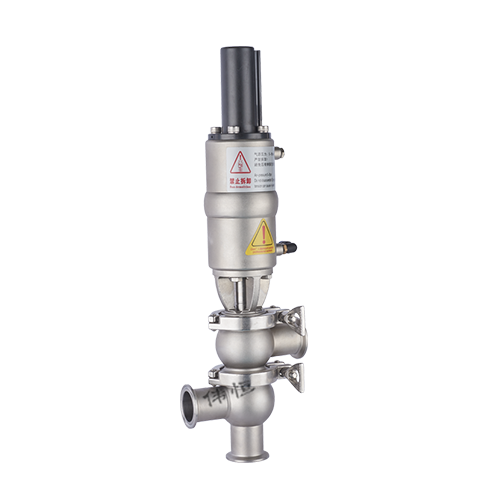
The Pneumatic Two-Way Three-Way Reversing Valve consists of several key components that work together to ensure reliable and efficient operation. Below is an overview of its main structural components:
The valve body houses all internal components, including the actuator, seals, and flow paths. Constructed from durable materials such as stainless steel or aluminum, the body is designed to withstand harsh conditions and prevent leakage.
The pneumatic actuator is responsible for moving the valve’s internal components. It uses compressed air to control the opening and closing of the valve, allowing for precise directional control. Depending on the application, the actuator can be spring-return or double-acting for faster and more reliable operation.
The seals and O-rings prevent leakage and ensure the valve operates smoothly without air loss. Made from high-quality elastomers like Viton or PTFE, they offer resistance to heat, abrasion, and chemical exposure, extending the valve's lifespan.
The flow path is where the compressed air or fluid flows through the valve. The valve is designed with multiple ports to handle both two-way and three-way flow configurations. Each port is precisely machined to ensure smooth and efficient flow through the valve.
Ensure that the valve is installed in a location that allows for easy access for maintenance and operation. Verify that the flow direction aligns with the valve's markings and that all connections are properly secured.
The Pneumatic Two-Way Three-Way Reversing Valve operates best with an air supply pressure between 4 to 8 bar. Verify that the air pressure is within the recommended range to ensure optimal valve performance.
Contaminants such as dirt, moisture, and debris can damage the internal components of the valve and reduce its lifespan. Always use clean, dry compressed air and install appropriate filtration systems to protect the valve from contaminants.
Regularly inspect the valve for signs of wear, corrosion, or leakage. Perform routine checks on the actuator, seals, and air supply lines to ensure the valve operates correctly. Lubricate moving parts as needed to prevent friction and enhance the valve's performance.
Here are common issues and solutions for the Pneumatic Two-Way Three-Way Reversing Valve:
| Issue | Possible Cause | Solution |
|---|---|---|
| Valve not actuating | Insufficient air pressure or actuator failure | Check air supply pressure and actuator function. Replace damaged components. |
| Leakage from valve body | Worn seals or improper installation | Inspect and replace worn seals or gaskets. Ensure proper installation torque. |
| Slow response time | Dirty or contaminated actuator or air supply | Clean the actuator and ensure proper air filtration. |
| Valve not switching correctly | Incorrect air supply pressure or mechanical blockages | Check and correct air pressure. Ensure no blockages in the actuator or ports. |
| Unstable flow control | Damaged seals or incorrect actuator alignment | Inspect and realign the actuator. Replace damaged seals. |
The Pneumatic Two-Way Three-Way Reversing Valve is a highly reliable and efficient solution for directional flow control in pneumatic systems. With its pneumatic actuation, durable construction, and space-saving design, it ensures precise control, reduced downtime, and optimal performance across various industrial applications.
By following the operation tips, regularly inspecting the valve, and addressing potential troubleshooting issues, you can ensure long-lasting, efficient operation. For further information, customizations, or technical support, feel free to reach out to our team.
 RELATED
 RELATED
 RELATED
 RELATED
Tel: +86 577 8699 9257
Tel: +86 135 8786 5766 /+86 137 32079372
Email: wzweiheng@163.com
Address:No. 1633, Yidaoba Road, Binhai Industrial Park, Wenzhou City, Zhejiang Province

Scan wechat
This website uses cookies to ensure you get the best experience on our website.
 Español
 Portugues
 Pусский
 Français
 Deutsch
 한국어
한국어 العربية
 Italiano
 ไทย
ไทย Türk dili
 हिन्दी
 Melayu
 Tiếng Việt
 dansk
dansk қазақ
қазақ বাংলা
বাংলা українська
 Filipino
 o'zbek



 Phone
Phone