

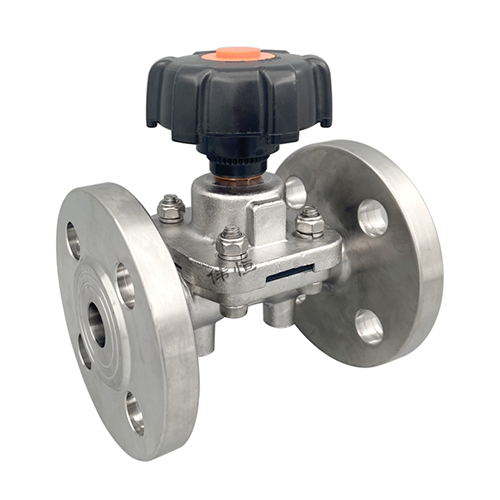
Flange Diaphragm Valve is a special form of cut-off valve, its opening and closing parts are a diaphragm made of soft material, separating the valve body cavity from the valve cover inner cavity and driving parts, so it is called diaphragm valve.
The most prominent feature of this valve is that the diaphragm separates the lower valve cavity from the upper valve cover inner cavity, so that the valve stem, valve disc and other parts located above the diaphragm are not corroded by the medium, eliminating the packing sealing structure, and will not produce media leakage. This valve uses a diaphragm made of rubber or plastic with a soft seal, which has good sealing.
However, since the separator is a wearing part, it should be replaced regularly depending on the characteristics of the medium. In addition, due to the limitation of the diaphragm material, the diaphragm valve is suitable for occasions with low pressure and relatively low temperature.
Diaphragm valves can be divided into six types according to their structural form: house type, DC type, shut-off type, straight through type, gate type and right angle type;
The connection form is usually flange connection; According to the drive mode, it can be divided into manual, electric and pneumatic, of which the pneumatic drive is divided into three types: normally open, normally closed and reciprocating.
The specific type of valve to choose needs to be decided according to the actual situation. If you need more information about flanged diaphragm valves, it is recommended to consult with a professional.
| Model representation method | ||||||||||||
| WH | -600 | —Q1 | —C1 | —F | —16 | —P | —25 | —D1 | —B | —W2 | —B2 | —L |
| >1. Weiheng brand | >2. Drive mode | >3. Valve body type | >4. Connection method | >5. Sealing material | >6. Nominal pressure | >7. Valve body material | >8. Nominal diameter | >9. Control mode | >10. Explosion-proof level | —20~150℃ | >12. Accessory options | >13. Three flows |
| 1~7 mandatory options, 8~13 optional | ||||||||||||
| 1 codename | 5 codename | Sealed material | 10 code | Explosion-proof rating | |
| WH | Weiheng brand | F | PTFE | B | ExdIl BT4 Gb explosionproof and explosion-proof type |
| PPL | Para-polyphenylene | BZ | ExdllCT5 Gb explosion-proof and explosion-proof type | ||
| 2 codename | Drive mode | H | Metal hard seal | BC | Exdll CT6 Gb explosionproof and explosion-proof type |
| 600 | Pneumatic actuator series | Y | cemented carbide | BM | ExmbllT4 Gb cast explosion-proof type |
| 900 | Electric actuator system | X1 | Ding Qing rubber NBR | BA | Exiall CT6Ga intrinsically safe and explosion-proof |
| 2001 | Column plastic actuator angle seat valve series | X2 | Natural rubber NR | ||
| 2002 | Stainless steel actuator angle seat valve series | X3 | EPDM | 11 codenames | Medium temperature |
| X4 | Viton rubber FPM | W1 | -20-80C | ||
| 3 codename | Body type | X5 | Food grade silicone rubber SI | W2 | -20-150C |
| Q1 | Two-way valve | F46 | Fully lined polyperfluoroethylene FEP | W3 | -20-250C |
| Q2 | Three-way valve | PFA | Fully lined with soluble PTFE PFA | W4 | -29-425C |
| Q3 | Four-way valve | F4 | Fully lined PTFE | W5 | -29-650C |
| Q4 | Stationary ball valve | N | nylon | W6 | -196-60C |
| Q5 | V-ball | TC | Lined ceramic | ...... | ...... |
| Q6 | Low profile ball valve | J | Rubber lining | It has a special temperature that can be designed and manufactured according to customer requirements | |
| Q7 | Sanitary grade ball valves | PEEK | Polyether ether ketone | ||
| Q8 | Plastic ball valves | W | When the ring | 12 codenames | Accessory selection |
| Q9 | High Vacuum Ball Valve | ...... | ...... | B1 | 2-position, 3-way solenoid valve |
| Q10 | Fluorine ball valve in the whole village | Other special sealing materials can be designed and manufactured according to customer requirements | B2 | 2-position 5-way solenoid valve | |
| Q11 | Cryogenic ball valves | B3 | 2-position 3-way explosion-proof solenoid valve | ||
| Q12 | Insulated ball valve | 6 codename | Nominal pressure | B4 | 2-position 5-way explosion-proof solenoid valve |
| Q13 | Eccentric hemispherical valve | ...... | ...... | B5 | Filter pressure reducing valve |
| Q14 | Tank bottom valve | B6 | Limit switch | ||
| Q15 | Ceramic ball valves | 7 codename | Body material | B7 | Explosion-proof limit switch |
| D1 | Centerline soft-sealed butterfly valve | Q | Ductile iron HT200 | B8 | Hand manipulation mechanism |
| D2 | 3. Eccentric butterfly valve | C | carbon steel | B9 | Locator |
| D3 | Sanitary Butterfly Valve | P | Stainless steel 304 | ...... | ...... |
| D4 | Plastic butterfly valve | R | Stainless steel 316 | ||
| D5 | Ventilation butterfly valve | PL | Stainless steel 304L | 13 codenames | Three flows |
| D6 | Fluorine butterfly valve in the whole village | RL | Stainless steel 316L | L | Tee L-type BC switching |
| D7 | High vacuum butterfly valve | U | PVC UPVC | T1 | Tee T-type C-port switch |
| D8 | Powder butterfly valve | PP | Reinforced polypropylene RPP | T2 | Tee T-type AB switching |
| Z1 | Gate valve | L | Aluminum alloy | T3 | Tee T-type AC switching |
| Z2 | Knife gate valve | ...... | ...... | T4 | Tee T-type B-port switch |
| J1 | Globe valve | Other special valve body materials can be designed and manufactured according to customer requirements | |||
| J2 | Bellows cut stop valve | ||||
| J3 | Angle seat valve | 8 codename | It is called the path | ||
| F1 | Upward expansion discharge valve | ...... | ...... | ||
| F2 | Downward discharge valve | ||||
| Other special valve body materials can be designed and manufactured according to customer requirements | 9 code | Control mode | |||
| Z | Standard switch type | ||||
| 4 codenames | Connection | T1 | Integral switching type | ||
| C1 | Female thread | T2 | Overall adjustment | ||
| C2 | By order | T3 | RS485 bus type | ||
| C3 | Male thread | D1 | Double acting | ||
| C4 | flange | D2 | Double-acting adjustment type | ||
| C5 | KF vacuum chuck | E1 | Uni-acting normally closed | ||
| C6 | weld | E2 | Single-acting normally closed regulation type | ||
| C7 | Pair clip | E3 | Single-acting and always open | ||
| C8 | Clamps | E4 | Single-acting normally open adjustment type | ||
The Sanitary Flange Diaphragm Valve is a key component for fluid handling systems requiring optimal hygiene, reliability, and performance. Commonly used in industries such as food processing, pharmaceuticals, and biotechnology, this valve is designed to provide precise control over fluid flow while meeting the stringent sanitary standards required in these industries.
This article will provide an in-depth overview of the Sanitary Flange Diaphragm Valve, covering its product advantages, key considerations, technical specifications, and energy efficiency standards. The content is structured for clarity and professionalism, making it ideal for use on corporate websites, B2B platforms, and other industrial applications.
A Sanitary Flange Diaphragm Valve is a type of valve designed to control the flow of fluids in sanitary systems. The diaphragm design ensures minimal contamination and reliable flow regulation. The flange connection allows for secure and leak-proof installation, ensuring durability and ease of maintenance. These valves are commonly used in industries where hygiene is paramount, such as in pharmaceutical manufacturing, food processing, and biotechnology.
Sanitary Design: The valve meets FDA, 3A, and EHEDG standards, ensuring compliance with stringent sanitary regulations for the food, beverage, and pharmaceutical industries.
Flanged Connection: Ensures secure installation and a leak-proof seal, preventing contamination and improving system reliability.
Diaphragm Construction: The diaphragm design provides smooth flow control while isolating the flow media from the valve mechanism, reducing the risk of contamination.
Durable Materials: Made from high-quality stainless steel (304 or 316L), the valve is corrosion-resistant, ensuring long-lasting performance even in harsh environments.
Easy Maintenance: The diaphragm valve is designed for easy disassembly and cleaning, ensuring that it remains hygienic and efficient in systems requiring frequent maintenance or sterilization.
The Sanitary Flange Diaphragm Valve offers a range of benefits that make it a preferred choice in industries where cleanliness, reliability, and durability are critical.
One of the most important advantages of this valve is its sanitary design. The diaphragm isolates the media from the valve mechanism, preventing contamination of the product. This is especially important in industries like food and beverage, where cross-contamination can affect product quality. The valve is easy to clean, ensuring that it meets the FDA and 3A standards for hygiene.
The flange connection provides a tight, secure seal that prevents leaks, even under high pressure or fluctuating temperatures. This leak-proof performance is critical in preventing fluid loss and ensuring the integrity of the system.
Made from high-quality stainless steel (304 or 316L), the valve resists corrosion from aggressive fluids, ensuring that it will maintain its functionality even in harsh chemical environments. This makes it ideal for applications in the pharmaceutical, biotechnology, and food industries.
The diaphragm design allows for easy disassembly and cleaning, minimizing downtime during maintenance or sterilization procedures. This feature is especially beneficial in systems where cleanliness is essential and frequent maintenance is required.
The Sanitary Flange Diaphragm Valve is suitable for a wide range of applications, including:
Food and Beverage Processing: Ensures hygienic fluid handling in production lines, minimizing the risk of contamination.
Pharmaceutical Manufacturing: Provides precise control over fluid flow, maintaining the purity and integrity of pharmaceutical products.
Biotechnology: Used in the production of biologics and other sensitive fluids where contamination risks must be minimized.
When selecting a Sanitary Flange Diaphragm Valve for your system, there are several important factors to consider to ensure that the valve will meet your needs and perform efficiently.
Ensure that the valve material is compatible with the fluids being handled. The valve body is typically made from stainless steel, but the diaphragm material may vary. Common diaphragm materials include:
PTFE (Polytetrafluoroethylene): Ideal for handling corrosive or high-temperature fluids.
EPDM (Ethylene Propylene Diene Monomer): Suitable for use with water and food products.
NBR (Nitrile Rubber): Commonly used in industrial applications where oil resistance is required.
The valve should be selected based on the pressure and temperature conditions of your system. Make sure the valve is rated to handle the maximum pressure and temperature levels expected during operation.
Choosing the correct valve size is critical for ensuring proper fluid flow and system performance. Oversized or undersized valves can lead to poor performance and reduced efficiency. Ensure that the valve size matches the pipe diameter and flow requirements of your system.
Look for valves that offer easy access to key components for maintenance and cleaning. A valve with an easily replaceable diaphragm and simple assembly can significantly reduce maintenance time and downtime.
Ensure that the valve complies with relevant industry standards such as FDA, 3A, EHEDG, and ISO 9001. Compliance with these standards guarantees that the valve meets strict hygiene, safety, and quality requirements.
Below is a table of key technical specifications for the Sanitary Flange Diaphragm Valve to assist in selecting the right valve for your application:
| Feature | Specification |
|---|---|
| Material | Stainless Steel (304 or 316L) |
| Diaphragm Material | PTFE, EPDM, NBR |
| Temperature Range | -10°C to 150°C (14°F to 302°F) |
| Pressure Range | 0-10 bar (0-145 psi) |
| Sealing Type | Flanged Connection, Leak-Proof |
| Compliance | FDA, 3A, EHEDG, ISO 9001 |
| Size Range | 1/2" to 6" |
| End Connections | Flanged, Tri-Clamp, Threaded |
These specifications ensure that the Sanitary Flange Diaphragm Valve is designed to meet the demanding requirements of various industrial applications while maintaining optimal hygiene standards.
While the Sanitary Flange Diaphragm Valve is primarily designed for fluid control and hygiene, it also offers benefits in terms of energy efficiency and environmental sustainability.
The diaphragm valve is designed to minimize friction, which leads to lower energy consumption when opening or closing the valve. This is particularly beneficial in systems where frequent valve operations are required. Additionally, the quick, easy maintenance and cleaning processes help reduce system downtime, ensuring that the entire system operates efficiently and sustainably.
The diaphragm design helps in reducing fluid wastage, as it provides precise flow control and ensures that the valve seats tightly, preventing leaks. This is particularly important in industries like pharmaceuticals and food processing, where waste reduction is a priority.
The corrosion-resistant materials and robust construction of the valve ensure long-term durability, reducing the need for frequent replacements and minimizing material waste over time.
The Sanitary Flange Diaphragm Valve offers a reliable, efficient, and hygienic solution for fluid control in a variety of industrial applications. Its leak-proof flanged connection, easy-to-clean diaphragm design, and compliance with sanitary standards make it an ideal choice for industries such as food processing, pharmaceuticals, and biotechnology. With its energy-efficient design and low maintenance requirements, it provides long-term value and ensures system reliability.
When selecting a valve for your system, be sure to consider factors such as material compatibility, pressure and temperature ratings, and ease of maintenance to ensure optimal performance.
 RELATED
 RELATED
Tel: +86 577 8699 9257
Tel: +86 135 8786 5766 /+86 137 32079372
Email: wzweiheng@163.com
Address:No. 1633, Yidaoba Road, Binhai Industrial Park, Wenzhou City, Zhejiang Province

Scan wechat
This website uses cookies to ensure you get the best experience on our website.
 Español
 Portugues
 Pусский
 Français
 Deutsch
 한국어
한국어 العربية
 Italiano
 ไทย
ไทย Türk dili
 हिन्दी
 Melayu
 Tiếng Việt
 dansk
dansk қазақ
қазақ বাংলা
বাংলা українська
 Filipino
 o'zbek



 Phone
Phone