

The Sanitary Handwheel Powder Discharge Butterfly Valve is a special type of valve that is commonly used in pharmaceuticals, food, and other industries that require high hygiene standards. The design and manufacture of such valves need to meet strict hygiene and cleanliness requirements to ensure that no contamination of materials is caused during operation.
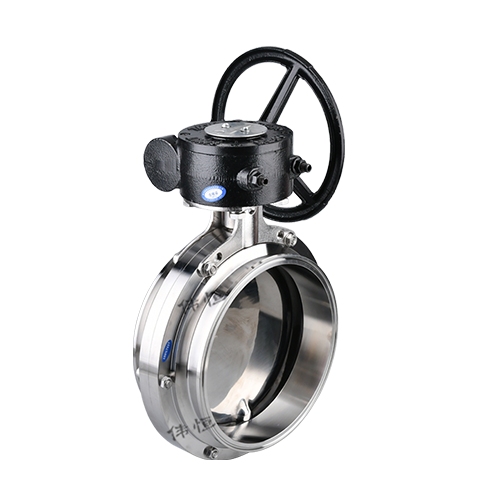
It is often used to control the flow of materials, especially when precise control of flow or to prevent blockages during conveying. This type of valve is mainly composed of a valve body, a disc and a handwheel. The valve body is typically a round housing that houses the disc. A disc is a disc that can rotate, by which it can open or close the valve port, thereby controlling the flow of materials. The handwheel is a device that can be manually rotated, through which the disc is rotated, so as to realize the opening and closing of the valve.
Sanitary Handwheel Powder Discharge Butterfly Valves are typically made of high-quality stainless steel materials, offering a high degree of corrosion resistance and wear resistance, ensuring a long-term service life. The structural design of valves is usually very simple, easy to clean and maintain, and can effectively reduce the growth of bacteria and dirt. In addition, this valve is usually equipped with high-precision sealing rings and sealing materials to ensure good sealing performance in the closed state and prevent material leakage and contamination.
In addition to meeting high hygiene standards, sanitary handwheel powder discharge butterfly valves also need to meet some other special requirements, such as easy operation, stability and reliability, explosion-proof and other characteristics. During installation and use, it is necessary to follow the instructions provided by the manufacturer for operation and maintenance to ensure the safety and effectiveness of the valve.
The Sanitary Handwheel Powder Discharge Butterfly Valve is a valve that meets high hygiene standards, with a high degree of corrosion resistance, wear resistance, and sealing properties, and is widely used in pharmaceutical, food, and other industries that require high hygiene standards.
| Model representation method | ||||||||||||
| WH | -600 | —Q1 | —C1 | —F | —16 | —P | —25 | —D1 | —B | —W2 | —B2 | —L |
| >1. Weiheng brand | >2. Drive mode | >3. Valve body type | >4. Connection method | >5. Sealing material | >6. Nominal pressure | >7. Valve body material | >8. Nominal diameter | >9. Control mode | >10. Explosion-proof level | —20~150℃ | >12. Accessory options | >13. Three flows |
| 1~7 mandatory options, 8~13 optional | ||||||||||||
| 1 codename | 5 codename | Sealed material | 10 code | Explosion-proof rating | |
| WH | Weiheng brand | F | PTFE | B | ExdIl BT4 Gb explosionproof and explosion-proof type |
| PPL | Para-polyphenylene | BZ | ExdllCT5 Gb explosion-proof and explosion-proof type | ||
| 2 codename | Drive mode | H | Metal hard seal | BC | Exdll CT6 Gb explosionproof and explosion-proof type |
| 600 | Pneumatic actuator series | Y | cemented carbide | BM | ExmbllT4 Gb cast explosion-proof type |
| 900 | Electric actuator system | X1 | Ding Qing rubber NBR | BA | Exiall CT6Ga intrinsically safe and explosion-proof |
| 2001 | Column plastic actuator angle seat valve series | X2 | Natural rubber NR | ||
| 2002 | Stainless steel actuator angle seat valve series | X3 | EPDM | 11 codenames | Medium temperature |
| X4 | Viton rubber FPM | W1 | -20-80C | ||
| 3 codename | Body type | X5 | Food grade silicone rubber SI | W2 | -20-150C |
| Q1 | Two-way valve | F46 | Fully lined polyperfluoroethylene FEP | W3 | -20-250C |
| Q2 | Three-way valve | PFA | Fully lined with soluble PTFE PFA | W4 | -29-425C |
| Q3 | Four-way valve | F4 | Fully lined PTFE | W5 | -29-650C |
| Q4 | Stationary ball valve | N | nylon | W6 | -196-60C |
| Q5 | V-ball | TC | Lined ceramic | ...... | ...... |
| Q6 | Low profile ball valve | J | Rubber lining | It has a special temperature that can be designed and manufactured according to customer requirements | |
| Q7 | Sanitary grade ball valves | PEEK | Polyether ether ketone | ||
| Q8 | Plastic ball valves | W | When the ring | 12 codenames | Accessory selection |
| Q9 | High Vacuum Ball Valve | ...... | ...... | B1 | 2-position, 3-way solenoid valve |
| Q10 | Fluorine ball valve in the whole village | Other special sealing materials can be designed and manufactured according to customer requirements | B2 | 2-position 5-way solenoid valve | |
| Q11 | Cryogenic ball valves | B3 | 2-position 3-way explosion-proof solenoid valve | ||
| Q12 | Insulated ball valve | 6 codename | Nominal pressure | B4 | 2-position 5-way explosion-proof solenoid valve |
| Q13 | Eccentric hemispherical valve | ...... | ...... | B5 | Filter pressure reducing valve |
| Q14 | Tank bottom valve | B6 | Limit switch | ||
| Q15 | Ceramic ball valves | 7 codename | Body material | B7 | Explosion-proof limit switch |
| D1 | Centerline soft-sealed butterfly valve | Q | Ductile iron HT200 | B8 | Hand manipulation mechanism |
| D2 | 3. Eccentric butterfly valve | C | carbon steel | B9 | Locator |
| D3 | Sanitary Butterfly Valve | P | Stainless steel 304 | ...... | ...... |
| D4 | Plastic butterfly valve | R | Stainless steel 316 | ||
| D5 | Ventilation butterfly valve | PL | Stainless steel 304L | 13 codenames | Three flows |
| D6 | Fluorine butterfly valve in the whole village | RL | Stainless steel 316L | L | Tee L-type BC switching |
| D7 | High vacuum butterfly valve | U | PVC UPVC | T1 | Tee T-type C-port switch |
| D8 | Powder butterfly valve | PP | Reinforced polypropylene RPP | T2 | Tee T-type AB switching |
| Z1 | Gate valve | L | Aluminum alloy | T3 | Tee T-type AC switching |
| Z2 | Knife gate valve | ...... | ...... | T4 | Tee T-type B-port switch |
| J1 | Globe valve | Other special valve body materials can be designed and manufactured according to customer requirements | |||
| J2 | Bellows cut stop valve | ||||
| J3 | Angle seat valve | 8 codename | It is called the path | ||
| F1 | Upward expansion discharge valve | ...... | ...... | ||
| F2 | Downward discharge valve | ||||
| Other special valve body materials can be designed and manufactured according to customer requirements | 9 code | Control mode | |||
| Z | Standard switch type | ||||
| 4 codenames | Connection | T1 | Integral switching type | ||
| C1 | Female thread | T2 | Overall adjustment | ||
| C2 | By order | T3 | RS485 bus type | ||
| C3 | Male thread | D1 | Double acting | ||
| C4 | flange | D2 | Double-acting adjustment type | ||
| C5 | KF vacuum chuck | E1 | Uni-acting normally closed | ||
| C6 | weld | E2 | Single-acting normally closed regulation type | ||
| C7 | Pair clip | E3 | Single-acting and always open | ||
| C8 | Clamps | E4 | Single-acting normally open adjustment type | ||
The Sanitary Handwheel Powder Discharge Butterfly Valve is an essential component for controlling the flow of powdered materials in sanitary systems. It is specifically designed to meet the high hygiene and operational standards required in industries such as food processing, pharmaceuticals, biotechnology, and cosmetics. With its stainless steel construction, easy-to-operate handwheel, and precise powder discharge mechanism, this valve ensures reliable, efficient, and hygienic fluid and powder handling.
This guide provides detailed information about the Sanitary Handwheel Powder Discharge Butterfly Valve, including packaging details, storage conditions, structural description, and usage recommendations, all optimized for Google SEO standards. Whether you're a procurement manager, engineer, or maintenance professional, this guide will help you make informed decisions regarding the use of this valve in your system.
The Sanitary Handwheel Powder Discharge Butterfly Valve is engineered to regulate the flow of powders and granular materials, while maintaining strict hygienic conditions in the process. Its handwheel operation offers manual control for precise adjustment of the valve opening, ensuring accurate discharge of powders from containers, hoppers, or tanks.
Sanitary Construction: Designed with hygienic materials such as 304 or 316L stainless steel, ensuring compliance with FDA, 3A, and EHEDG standards for sanitary applications.
Handwheel Operation: Provides easy manual operation for regulating the flow of powders, offering precise control in critical applications.
Leak-Proof Design: Equipped with high-quality seals and gaskets that prevent powder leakage, minimizing contamination risk.
Corrosion and Wear Resistance: The valve's construction is highly resistant to corrosion, ensuring long-lasting performance even in harsh processing environments.
Versatility: Suitable for use in a wide range of industries including food processing, pharmaceuticals, cosmetics, and chemical handling.
Food Industry: Handling of powdered ingredients such as flour, sugar, and spices in food processing and packaging lines.
Pharmaceuticals: Discharge of active pharmaceutical ingredients (APIs) and excipients, ensuring contamination-free flow.
Cosmetic Manufacturing: Safe handling of cosmetic powders, such as talc or colorants, in the production process.
Chemical Processing: Accurate powder handling in chemical production and packaging systems.
The Sanitary Handwheel Powder Discharge Butterfly Valve is designed with simplicity and efficiency in mind. Below is an in-depth look at its key structural components:
Material: The valve body is made from 304 or 316L stainless steel, offering superior resistance to corrosion and high durability.
Shape: The valve features a butterfly design, where a disc is positioned in the center of the flow path. When the valve is opened, the disc rotates to allow material to flow, and when closed, the disc creates a seal to prevent leakage.
The handwheel is used for manually operating the valve. It connects directly to the valve stem, allowing for easy adjustment of the disc’s position.
Ergonomically Designed: The handwheel is designed for easy grip and rotation, even in environments where gloves are worn.
Material: Constructed from stainless steel for durability, it is resistant to wear and tear from constant use.
Material: The seals are typically made from EPDM, PTFE, or NBR, depending on the application requirements.
These seals prevent leakage of powders, ensuring that no contamination occurs during operation.
In addition to manual handwheel operation, the valve can be fitted with an electric or pneumatic actuator for automated control in larger systems.
Materials: Actuators are typically made from aluminum or stainless steel, providing long service life in high-demand environments.
The valve can be configured with flanged, tri-clamp, or threaded connections, allowing it to integrate seamlessly into existing systems.
The valve is designed with an indicated flow direction, ensuring that the powder flows through the system in the correct direction for optimal operation.
Proper packaging is essential to ensure the safe delivery and storage of the Sanitary Handwheel Powder Discharge Butterfly Valve. The valve is typically packaged as follows:
Individual Packaging: Each valve is carefully wrapped in bubble wrap or foam to protect it from damage during transportation.
Outer Packaging: The valve is placed in a corrugated cardboard box or wooden crate, depending on size, to prevent external damage during shipping.
Seals: Each valve is sealed to ensure cleanliness, preventing any contamination during transit.
International Shipping: The valves can be shipped worldwide via sea freight, air freight, or courier services, depending on customer preferences and delivery timelines.
Customs Compliance: Shipping documentation is provided to meet international customs requirements, including product specifications, materials, and certifications.
Proper storage of the Sanitary Handwheel Powder Discharge Butterfly Valve is vital to maintain its integrity and functionality. Here are the recommended storage conditions:
Store the valve in a cool, dry place with a temperature range between -10°C and 40°C (14°F to 104°F) to avoid material degradation.
Keep the valve in a low-humidity environment to prevent rust or corrosion. Excess moisture can also degrade the seals and other components over time.
Ensure the valve is sealed in its original packaging or covered with protective plastic to avoid exposure to dust, dirt, or other contaminants.
Storage Orientation: Store the valve upright, avoiding heavy objects on top that may cause damage.
Do not expose the valve to direct sunlight for extended periods, as UV exposure can degrade the material, especially rubber seals and gaskets.
To ensure the Sanitary Handwheel Powder Discharge Butterfly Valve operates at its best, the following usage recommendations should be followed:
Correct Sizing: Choose the appropriate valve size based on your system's pipeline diameter and expected flow rates. Using a valve that is too small or too large can cause inefficiencies or operational issues.
End Connections: Make sure the valve's end connections (flanged, tri-clamp, or threaded) are compatible with your piping system. This ensures a secure and leak-proof installation.
Ensure that the operating pressure and temperature conditions do not exceed the valve's maximum ratings, which are typically 10 bar (145 psi) and 150°C (302°F). Exceeding these limits can cause damage to the valve body, seals, and internal components.
The handwheel allows for precise flow control of powders. Always adjust the handwheel slowly and carefully to avoid over-tightening or damaging the internal components. Avoid sudden movements that may disrupt the flow or cause blockages.
Clean-In-Place (CIP) systems are recommended for industries like food processing and pharmaceuticals. Regular cleaning is essential to remove any residual powders and prevent contamination.
Use only food-safe or pharmaceutical-grade cleaning agents to avoid damaging the valve components or contaminating your product.
Inspect seals and gaskets regularly for wear and replace them as needed. Use only genuine replacement parts to maintain the valve's integrity.
If the valve is part of a high-volume production system, schedule routine inspections to ensure the valve’s seals, handwheel, and disc are functioning correctly.
Here is some feedback from customers who have used the Sanitary Handwheel Powder Discharge Butterfly Valve in their operations:
"Excellent Powder Control": A customer in the food industry commented, "We use this valve for controlling the flow of powdered sugar in our packaging line. The handwheel allows for very precise control, and we haven’t had any issues with leaks or contamination."
"Perfect for Sterile Environments": A pharmaceutical customer said, "We use this valve in our production line, and it’s ideal for handling active pharmaceutical ingredients. Its sanitary design and reliable performance meet our strict requirements."
"Initial Installation Requires Care": One customer mentioned, "The valve works great, but the initial installation required some attention to detail. Be sure to follow the installation guide closely to avoid any alignment issues."
"Handwheel Could Be More Ergonomic": A customer suggested that the handwheel could be slightly larger for more ergonomic handling, especially in high-volume applications.
The Sanitary Handwheel Powder Discharge Butterfly Valve is a versatile and reliable solution for controlling the flow of powders and granular materials in sanitary applications. Its easy-to-use handwheel operation, hygienic design, and long-lasting construction make it ideal for industries where contamination control and reliable performance are critical.
By following the storage conditions, usage recommendations, and maintenance guidelines provided in this guide, you can ensure optimal performance and longevity of the valve. Whether you're in food processing, pharmaceuticals, or any other industry requiring hygienic powder handling, the Sanitary Handwheel Powder Discharge Butterfly Valve is designed to meet your needs with precision and efficiency.
 RELATED
 RELATED
 RELATED
Tel: +86 577 8699 9257
Tel: +86 135 8786 5766 /+86 137 32079372
Email: wzweiheng@163.com
Address:No. 1633, Yidaoba Road, Binhai Industrial Park, Wenzhou City, Zhejiang Province

Scan wechat
This website uses cookies to ensure you get the best experience on our website.
 Español
 Portugues
 Pусский
 Français
 Deutsch
 한국어
한국어 العربية
 Italiano
 ไทย
ไทย Türk dili
 हिन्दी
 Melayu
 Tiếng Việt
 dansk
dansk қазақ
қазақ বাংলা
বাংলা українська
 Filipino
 o'zbek



 Phone
Phone