

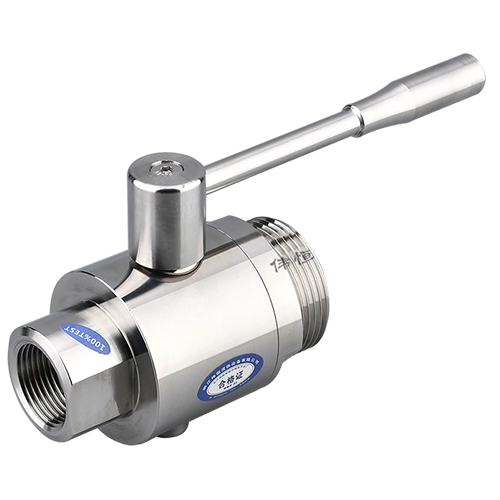
Sanitary two-piece internal and external thread forged fixed ball valve is a valve that meets hygiene standards, it adopts a two-piece structure, with the characteristics of internal and external thread forging, and is suitable for fluid piping systems in food, pharmaceutical, bioengineering and other industries.
The valve is mainly composed of a valve body, valve spool and seal, of which the valve body is manufactured using a forging process, which makes the valve body structure more compact and stronger. The valve spool adopts a spherical structure, which has the advantages of fast switching and good sealing effect. The seals are manufactured from food-grade materials and comply with relevant hygiene standards.
When using sanitary two-piece internal and external forged fixed ball valves, it is necessary to ensure the correct direction and position of the valve during the installation process to avoid excessive external force impact. During operation, open the valve gradually to avoid sudden opening or closing that can cause damage to the valve. In addition, the valve should be regularly inspected and maintained to ensure the normal operation and sealing effect of the valve.
In short, the sanitary two-piece internal and external thread forged fixed ball valve is a valve with reasonable structure, good sealing performance, high temperature and high pressure resistance, and corrosion resistance, which meets relevant hygiene standards and is suitable for fluid piping systems in food, pharmaceutical, bioengineering and other industries.
| name | Two-piece internal and external thread forged fixed ball valve |
| It is called the path | DN15-DN200mm |
| Nominal pressure | 1.6Mpa (If you need other pressure standards, please specify when ordering) |
| Connection | Quick assembly, clamps, quick cards, chucks |
| Body material | Carbon Steel (C) Stainless Steel 304 (P) Stainless Steel 316 (R) |
| Surface treatment | Mirror polishing inside and outside |
| Sealed material | Teflon (PTFE), EPDM, Silicone Rubber (VMQ), Butadiene Rubber (NBR), Fluorinated Rubber (FPM), Metal Seals (H), Carbide (Y) |
| Use the medium | Gas, liquid, oil, vacuum, water vapor |
| Medium temperature | -20℃-150℃(F) 、 -20℃-250℃ (PPL) 、-29℃-425℃(H)(Y) |
| apply | This type of ball valve series is a hygienic type of valve series for material transfer control. It is widely used in food and beverage processing, as well as in the pharmaceutical and chemical industries |
| standard | DIN standard series, 3A standard series SMS standard series, ISO/IDF standard series, BS/RJT standard series, ASME/BPE, etc. (There are various standard valve series that can be provided to customers) |
| The components of ball valves generally include: | A handle, a ball with a through cavity, valve body, valve core and shaft seal |
| Model representation method | ||||||||||||
| WH | -600 | —Q1 | —C1 | —F | —16 | —P | —25 | —D1 | —B | —W2 | —B2 | —L |
| >1. Weiheng brand | >2. Drive mode | >3. Valve body type | >4. Connection method | >5. Sealing material | >6. Nominal pressure | >7. Valve body material | >8. Nominal diameter | >9. Control mode | >10. Explosion-proof level | —20~150℃ | >12. Accessory options | >13. Three flows |
| 1~7 mandatory options, 8~13 optional | ||||||||||||
| 1 codename | 5 codename | Sealed material | 10 code | Explosion-proof rating | |
| WH | Weiheng brand | F | PTFE | B | ExdIl BT4 Gb explosionproof and explosion-proof type |
| PPL | Para-polyphenylene | BZ | ExdllCT5 Gb explosion-proof and explosion-proof type | ||
| 2 codename | Drive mode | H | Metal hard seal | BC | Exdll CT6 Gb explosionproof and explosion-proof type |
| 600 | Pneumatic actuator series | Y | cemented carbide | BM | ExmbllT4 Gb cast explosion-proof type |
| 900 | Electric actuator system | X1 | Ding Qing rubber NBR | BA | Exiall CT6Ga intrinsically safe and explosion-proof |
| 2001 | Column plastic actuator angle seat valve series | X2 | Natural rubber NR | ||
| 2002 | Stainless steel actuator angle seat valve series | X3 | EPDM | 11 codenames | Medium temperature |
| X4 | Viton rubber FPM | W1 | -20-80C | ||
| 3 codename | Body type | X5 | Food grade silicone rubber SI | W2 | -20-150C |
| Q1 | Two-way valve | F46 | Fully lined polyperfluoroethylene FEP | W3 | -20-250C |
| Q2 | Three-way valve | PFA | Fully lined with soluble PTFE PFA | W4 | -29-425C |
| Q3 | Four-way valve | F4 | Fully lined PTFE | W5 | -29-650C |
| Q4 | Stationary ball valve | N | nylon | W6 | -196-60C |
| Q5 | V-ball | TC | Lined ceramic | ...... | ...... |
| Q6 | Low profile ball valve | J | Rubber lining | It has a special temperature that can be designed and manufactured according to customer requirements | |
| Q7 | Sanitary grade ball valves | PEEK | Polyether ether ketone | ||
| Q8 | Plastic ball valves | W | When the ring | 12 codenames | Accessory selection |
| Q9 | High Vacuum Ball Valve | ...... | ...... | B1 | 2-position, 3-way solenoid valve |
| Q10 | Fluorine ball valve in the whole village | Other special sealing materials can be designed and manufactured according to customer requirements | B2 | 2-position 5-way solenoid valve | |
| Q11 | Cryogenic ball valves | B3 | 2-position 3-way explosion-proof solenoid valve | ||
| Q12 | Insulated ball valve | 6 codename | Nominal pressure | B4 | 2-position 5-way explosion-proof solenoid valve |
| Q13 | Eccentric hemispherical valve | ...... | ...... | B5 | Filter pressure reducing valve |
| Q14 | Tank bottom valve | B6 | Limit switch | ||
| Q15 | Ceramic ball valves | 7 codename | Body material | B7 | Explosion-proof limit switch |
| D1 | Centerline soft-sealed butterfly valve | Q | Ductile iron HT200 | B8 | Hand manipulation mechanism |
| D2 | 3. Eccentric butterfly valve | C | carbon steel | B9 | Locator |
| D3 | Sanitary Butterfly Valve | P | Stainless steel 304 | ...... | ...... |
| D4 | Plastic butterfly valve | R | Stainless steel 316 | ||
| D5 | Ventilation butterfly valve | PL | Stainless steel 304L | 13 codenames | Three flows |
| D6 | Fluorine butterfly valve in the whole village | RL | Stainless steel 316L | L | Tee L-type BC switching |
| D7 | High vacuum butterfly valve | U | PVC UPVC | T1 | Tee T-type C-port switch |
| D8 | Powder butterfly valve | PP | Reinforced polypropylene RPP | T2 | Tee T-type AB switching |
| Z1 | Gate valve | L | Aluminum alloy | T3 | Tee T-type AC switching |
| Z2 | Knife gate valve | ...... | ...... | T4 | Tee T-type B-port switch |
| J1 | Globe valve | Other special valve body materials can be designed and manufactured according to customer requirements | |||
| J2 | Bellows cut stop valve | ||||
| J3 | Angle seat valve | 8 codename | It is called the path | ||
| F1 | Upward expansion discharge valve | ...... | ...... | ||
| F2 | Downward discharge valve | ||||
| Other special valve body materials can be designed and manufactured according to customer requirements | 9 code | Control mode | |||
| Z | Standard switch type | ||||
| 4 codenames | Connection | T1 | Integral switching type | ||
| C1 | Female thread | T2 | Overall adjustment | ||
| C2 | By order | T3 | RS485 bus type | ||
| C3 | Male thread | D1 | Double acting | ||
| C4 | flange | D2 | Double-acting adjustment type | ||
| C5 | KF vacuum chuck | E1 | Uni-acting normally closed | ||
| C6 | weld | E2 | Single-acting normally closed regulation type | ||
| C7 | Pair clip | E3 | Single-acting and always open | ||
| C8 | Clamps | E4 | Single-acting normally open adjustment type | ||
Sanitary Two-Piece Internal and External Thread Forged Fixed Ball Valve
The sanitary two-piece internal and external thread forged fixed ball valve is a precision-engineered valve designed for hygienic, corrosion-resistant, and pressure-stable applications. Manufactured using high-grade forged stainless steel, this valve ensures tight sealing, smooth flow control, and long-term operational reliability. Due to its hygienic construction, compact design, and threaded connection options, it is widely used in food processing, dairy systems, pharmaceutical production, clean water supply, brewery pipelines, and chemical applications requiring strict sanitary compliance.
Compared with cast ball valves, forged ball valves offer enhanced mechanical strength, uniform material structure, and better resistance to pressure and impact. The two-piece design provides easier assembly, maintenance, and replacement, making it highly suitable for facilities that require frequent cleaning, sanitation, and CIP operations.
2. Key Features and Advantages
The valve body is forged from high-purity stainless steel such as SS304 or SS316L, ensuring superior resistance to corrosion, scaling, and microbiological contamination. The smooth inner surface minimizes fluid residue and meets strict sanitary standards for food-grade and pharmaceutical pipelines.
The two-piece configuration enables quick removal of the ball and seat without dismantling the entire pipeline. This reduces downtime and improves maintenance efficiency, especially in continuous production environments.
The forged fixed ball valve is available with various thread standards, including:
NPT
BSPT
BSPP
DIN, ISO, SMS sanitary threads
This flexibility ensures compatibility with global pipeline systems and simplifies integration in international processing lines.
The fixed ball design reduces torque requirements, maintains stable sealing performance under high pressure, and ensures smooth flow regulation. It also minimizes potential wear on the valve seat, extending operational life.
The precision-machined ball and PTFE/TFM seats provide low-friction, bubble-tight sealing. The design prevents leakage even after extended cycles, making it ideal for hygienic systems requiring absolute cleanliness.
The valve’s full-port design minimizes pressure loss, reduces pump energy consumption, and improves system throughput. Its smooth interior eliminates turbulence and ensures efficient use of energy across the pipeline system.
3. Technical Specifications
The following table summarizes typical specifications for sanitary thread forged ball valves. Values can vary depending on model, manufacturer, and application.
| Parameter | Specification |
|---|---|
| Valve Type | Two-piece forged fixed ball valve |
| Connection | Internal & external threaded (NPT/BSP/DIN) |
| Size Range | 1/4" – 4" |
| Body Material | SS304, SS316, SS316L |
| Seat Material | PTFE / TFM / PCTFE |
| Ball Material | Polished stainless steel |
| Pressure Rating | PN16–PN63 / 1000–2000 PSI |
| Temperature Range | -20°C to 200°C (depending on seal material) |
| Surface Finish | Ra ≤ 0.8 μm (sanitary grade) |
| Operation | Manual, pneumatic, or electric |
| Compliance | FDA, CE, ISO 9001, 3A (optional), SGS test available |
4. Energy-Saving Standards
Energy conservation is crucial in modern production environments. This Sanitary Forged Ball Valve complies with multiple energy-saving criteria:
The fixed ball design and polished sealing surfaces reduce torque, enabling:
Smaller electric or pneumatic actuators
Lower operational load
Reduced overall energy consumption
The full-bore internal structure ensures maximum flow with minimal resistance:
Reduced pump pressure requirements
Lower electricity usage
Stable flow velocity for CIP cleaning
Efficient sealing reduces:
Product waste
Water consumption in sanitary rinsing
Clean-in-place cycle durations, saving steam and chemicals
Depending on the application, the valve can support compliance with:
ISO energy efficiency guidelines
3A sanitary flow efficiency standards
EU energy-saving directives for processing equipment
5. Quality Inspection and Test Reports
To ensure reliability, each valve undergoes comprehensive inspections and certified testing procedures.
Forged stainless steel provides high mechanical integrity. The valve body is tested for:
Tensile strength
Pressure resistance
Elastic deformation limits
Each valve undergoes 100% hydrostatic testing to ensure the body and seat can withstand rated pressures without leakage.
Low-pressure air testing ensures bubble-tight sealing for hygienic use.
Manufacturers typically provide:
EN10204 3.1 Material Certificates
SGS Testing Reports
FDA Compliance Documentation for PTFE/TFM seats
The polished internal surfaces are verified using advanced measuring tools to ensure:
Smoothness for sanitary applications
No impurities or welding defects
Threaded ends are examined using calibrated thread gauges to ensure 100% accuracy and compatibility with international standards.
6. Applications
The sanitary two-piece internal and external thread forged fixed ball valve is suitable for industries requiring hygienic flow control, including:
Dairy lines
Beverage production
Breweries and wineries
Edible oil pipelines
Purified water systems
Medical solutions manufacturing
Sterile product processing
Fragrance blending
Cleaning solution handling
Chemical dosing systems
Clean and filtered water
RO/UF systems
Sterilization units
7. Installation and Usage Precautions
Proper installation ensures optimal performance and safety.
Before installation, verify:
Valve size and thread type match the pipeline
No debris or dust inside the valve
Seal materials are compatible with the media
Install the valve in the correct flow direction if specified.
Use appropriate thread sealant (PTFE tape or food-grade sealant).
Avoid over-tightening to prevent damaging the threads.
Ensure proper alignment to avoid structural stress.
Do not exceed rated pressure or temperature.
Avoid sudden valve operation at high flow rates to prevent water hammer.
Keep the valve fully open during cleaning to avoid residue buildup.
Wear protective equipment during maintenance.
Ensure line pressure is released before disassembly.
Avoid using the valve for abrasive or high-viscosity fluids unless approved.
8. Inspection and Maintenance Guide
Routine maintenance helps extend valve service life and maintain sanitary compliance.
| Task | Frequency |
|---|---|
| Leak inspection | Weekly |
| Torque and handle check | Monthly |
| Internal cleaning | As required (CIP/SIP cycles) |
| Seat and gasket replacement | Every 6–12 months |
| Full valve overhaul | Annually |
For sanitary pipelines, regular CIP (Clean-In-Place) is essential:
Flush with warm water
Circulate food-grade caustic cleaners
Rinse thoroughly to remove residues
Use SIP (Steam-In-Place) where necessary
Food-grade lubricants should be applied to the stem and threads to maintain smooth operation.
When leakage or wear is discovered:
Remove the valve from the pipeline
Replace PTFE/TFM seats and O-rings
Reassemble and retest pressure
| Problem | Possible Causes | Solutions |
|---|---|---|
| Leakage at threads | Loose connection, inferior sealant | Reapply PTFE tape, tighten properly |
| Internal leakage | Worn seat or ball surface | Replace seat or ball |
| High torque | Lack of lubrication, contamination | Clean and lubricate |
| Vibration | High flow velocity | Install supports or flow stabilizers |
9. Benefits for Industrial Users
This threaded forged ball valve offers multiple advantages for businesses:
Reduced maintenance cost
Improved energy efficiency in pipeline operations
Extended service life due to forged steel durability
Enhanced sanitary safety for food and pharmaceutical applications
Global compatibility with multiple thread standards
Compact design, easy installation, and low downtime
10. Conclusion
The sanitary two-piece internal and external thread forged fixed ball valve is a high-precision, durable, and hygienic solution for modern industrial fluid control. With superior sealing performance, full-port flow efficiency, energy-saving features, and international compliance certifications, this valve is an excellent choice for manufacturers seeking reliable and sanitary pipeline components.
Its two-piece design simplifies maintenance, while its forged construction ensures long-term stability and corrosion resistance. Whether used in food production, biotechnology, clean water systems, or chemical processing, this valve supports safe, efficient, and environmentally responsible operation.
Tel: +86 577 8699 9257
Tel: +86 135 8786 5766 /+86 137 32079372
Email: wzweiheng@163.com
Address:No. 1633, Yidaoba Road, Binhai Industrial Park, Wenzhou City, Zhejiang Province

Scan wechat
This website uses cookies to ensure you get the best experience on our website.
 Español
 Portugues
 Pусский
 Français
 Deutsch
 한국어
한국어 العربية
 Italiano
 ไทย
ไทย Türk dili
 हिन्दी
 Melayu
 Tiếng Việt
 dansk
dansk қазақ
қазақ বাংলা
বাংলা українська
 Filipino
 o'zbek



 Phone
Phone