

A six-way welded joint is a type of pipe fitting that connects two or more pipes or fittings, typically made of stainless steel or carbon steel. This type of joint has six channels and can connect two or more pipes or fittings at the same time, so it is called a six-way fitting.
The advantages of six-way solder joints include:
It has a compact structure and small footprint, making it suitable for space-constrained occasions.
The connection is reliable, not easy to leak, and can ensure the tightness of the fluid medium.
It can withstand high pressures and temperatures, and is suitable for the transfer of various fluid media.
Easy installation and quick connection of two pipes or fittings, reducing installation time and costs.
When using six-way solder joints, you need to pay attention to the following points:
Choose the appropriate fitting type and specification to ensure a match with the pipe or fitting.
During the welding process, ensure the cleanliness and dryness of the joints to avoid affecting the welding quality and sealing performance.
During the installation process, ensure that the connectors are securely connected to avoid loosening or leakage.
During use, the sealing performance and integrity of the joint should be checked regularly, and if there is any abnormality, it should be dealt with or replaced in time.
In short, six-way welded joints are widely used in the connection of various pipes and fittings, which can ensure the sealing and transmission effect of fluid media. During use, it should be operated in strict accordance with the operating procedures, and regular maintenance and maintenance should be carried out. If necessary, it is recommended to consult our professionals or consult relevant books.
| Model representation method | ||||||||||||
| WH | -600 | —Q1 | —C1 | —F | —16 | —P | —25 | —D1 | —B | —W2 | —B2 | —L |
| >1. Weiheng brand | >2. Drive mode | >3. Valve body type | >4. Connection method | >5. Sealing material | >6. Nominal pressure | >7. Valve body material | >8. Nominal diameter | >9. Control mode | >10. Explosion-proof level | —20~150℃ | >12. Accessory options | >13. Three flows |
| 1~7 mandatory options, 8~13 optional | ||||||||||||
| 1 codename | 5 codename | Sealed material | 10 code | Explosion-proof rating | |
| WH | Weiheng brand | F | PTFE | B | ExdIl BT4 Gb explosionproof and explosion-proof type |
| PPL | Para-polyphenylene | BZ | ExdllCT5 Gb explosion-proof and explosion-proof type | ||
| 2 codename | Drive mode | H | Metal hard seal | BC | Exdll CT6 Gb explosionproof and explosion-proof type |
| 600 | Pneumatic actuator series | Y | cemented carbide | BM | ExmbllT4 Gb cast explosion-proof type |
| 900 | Electric actuator system | X1 | Ding Qing rubber NBR | BA | Exiall CT6Ga intrinsically safe and explosion-proof |
| 2001 | Column plastic actuator angle seat valve series | X2 | Natural rubber NR | ||
| 2002 | Stainless steel actuator angle seat valve series | X3 | EPDM | 11 codenames | Medium temperature |
| X4 | Viton rubber FPM | W1 | -20-80C | ||
| 3 codename | Body type | X5 | Food grade silicone rubber SI | W2 | -20-150C |
| Q1 | Two-way valve | F46 | Fully lined polyperfluoroethylene FEP | W3 | -20-250C |
| Q2 | Three-way valve | PFA | Fully lined with soluble PTFE PFA | W4 | -29-425C |
| Q3 | Four-way valve | F4 | Fully lined PTFE | W5 | -29-650C |
| Q4 | Stationary ball valve | N | nylon | W6 | -196-60C |
| Q5 | V-ball | TC | Lined ceramic | ...... | ...... |
| Q6 | Low profile ball valve | J | Rubber lining | It has a special temperature that can be designed and manufactured according to customer requirements | |
| Q7 | Sanitary grade ball valves | PEEK | Polyether ether ketone | ||
| Q8 | Plastic ball valves | W | When the ring | 12 codenames | Accessory selection |
| Q9 | High Vacuum Ball Valve | ...... | ...... | B1 | 2-position, 3-way solenoid valve |
| Q10 | Fluorine ball valve in the whole village | Other special sealing materials can be designed and manufactured according to customer requirements | B2 | 2-position 5-way solenoid valve | |
| Q11 | Cryogenic ball valves | B3 | 2-position 3-way explosion-proof solenoid valve | ||
| Q12 | Insulated ball valve | 6 codename | Nominal pressure | B4 | 2-position 5-way explosion-proof solenoid valve |
| Q13 | Eccentric hemispherical valve | ...... | ...... | B5 | Filter pressure reducing valve |
| Q14 | Tank bottom valve | B6 | Limit switch | ||
| Q15 | Ceramic ball valves | 7 codename | Body material | B7 | Explosion-proof limit switch |
| D1 | Centerline soft-sealed butterfly valve | Q | Ductile iron HT200 | B8 | Hand manipulation mechanism |
| D2 | 3. Eccentric butterfly valve | C | carbon steel | B9 | Locator |
| D3 | Sanitary Butterfly Valve | P | Stainless steel 304 | ...... | ...... |
| D4 | Plastic butterfly valve | R | Stainless steel 316 | ||
| D5 | Ventilation butterfly valve | PL | Stainless steel 304L | 13 codenames | Three flows |
| D6 | Fluorine butterfly valve in the whole village | RL | Stainless steel 316L | L | Tee L-type BC switching |
| D7 | High vacuum butterfly valve | U | PVC UPVC | T1 | Tee T-type C-port switch |
| D8 | Powder butterfly valve | PP | Reinforced polypropylene RPP | T2 | Tee T-type AB switching |
| Z1 | Gate valve | L | Aluminum alloy | T3 | Tee T-type AC switching |
| Z2 | Knife gate valve | ...... | ...... | T4 | Tee T-type B-port switch |
| J1 | Globe valve | Other special valve body materials can be designed and manufactured according to customer requirements | |||
| J2 | Bellows cut stop valve | ||||
| J3 | Angle seat valve | 8 codename | It is called the path | ||
| F1 | Upward expansion discharge valve | ...... | ...... | ||
| F2 | Downward discharge valve | ||||
| Other special valve body materials can be designed and manufactured according to customer requirements | 9 code | Control mode | |||
| Z | Standard switch type | ||||
| 4 codenames | Connection | T1 | Integral switching type | ||
| C1 | Female thread | T2 | Overall adjustment | ||
| C2 | By order | T3 | RS485 bus type | ||
| C3 | Male thread | D1 | Double acting | ||
| C4 | flange | D2 | Double-acting adjustment type | ||
| C5 | KF vacuum chuck | E1 | Uni-acting normally closed | ||
| C6 | weld | E2 | Single-acting normally closed regulation type | ||
| C7 | Pair clip | E3 | Single-acting and always open | ||
| C8 | Clamps | E4 | Single-acting normally open adjustment type | ||
Six-Way Welded Joint: Comprehensive Guide to Installation, Advantages, and Certification
The Six-Way Welded Joint is a versatile and durable pipe fitting designed for use in complex piping systems across industries such as chemical processing, oil and gas, food and beverage, and pharmaceuticals. Known for its exceptional corrosion resistance and strength, the six-way welded joint allows for the efficient branching of multiple pipe connections, ensuring high-performance fluid distribution. This guide will explore the installation process, common questions, product certifications, and technical advantages of the Six-Way Welded Joint, offering comprehensive insight into its features and applications.
| Feature | Benefit |
|---|---|
| Material | Made from high-grade stainless steel (304/316L), providing corrosion resistance and durability in harsh environments. |
| Design | Six-way branching design for efficient fluid distribution, ideal for complex piping systems. |
| Welded Construction | Offers enhanced structural integrity and the ability to handle high-pressure and high-temperature applications. |
| Sealing | Equipped with leak-proof seals to ensure a secure and contamination-free connection. |
| Versatility | Available in various sizes and compatible with most standard piping systems and pipe materials. |
| Quality Assurance | Product certified for compliance with international standards like ISO, CE, and 3-A, ensuring reliable performance. |
Proper installation is essential for ensuring the optimal performance of the Six-Way Welded Joint. Below are the steps for installing this joint into your system.
Before installation, ensure all components are ready:
Inspect the Joint: Verify that the joint is free from damage and that all welds are intact.
Check Pipe Size: Ensure the pipes to be connected match the diameter and material specifications of the welded joint.
Clean the System: Clean all the pipes and the joint to remove debris or contaminants that could affect performance.
The Six-Way Welded Joint is designed to be welded directly into your piping system.
Step 1: Place the six-way joint in the desired location.
Step 2: Ensure proper alignment of all pipe connections to avoid stress on the joint during operation.
Step 3: Use TIG welding (Tungsten Inert Gas) or MIG welding (Metal Inert Gas), depending on the material of your piping system.
Step 4: Carefully weld each section of the joint, making sure the welds are clean and strong to ensure the integrity of the connection.
Once the joint is welded into place, it’s crucial to perform the following checks:
Pressure Testing: Perform a hydrostatic test or air pressure test to check for leaks or weaknesses in the welds.
Visual Inspection: Inspect the joint for any signs of corrosion, cracks, or other visible issues.
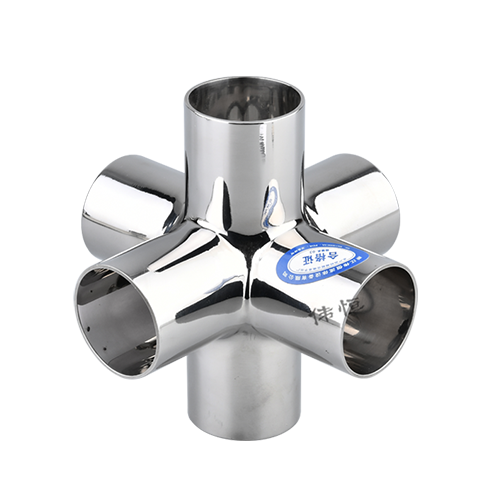
The Six-Way Welded Joint offers the unique ability to connect multiple pipes at various angles, enabling efficient and compact fluid distribution. Its welded design ensures that it can withstand high-pressure environments, making it ideal for complex systems that require high-strength connections.
The Six-Way Welded Joint is typically made from stainless steel 304 or 316L, which are highly resistant to corrosion, rust, and wear. 316L is preferred for more demanding environments, such as those exposed to harsh chemicals or high temperatures.
Yes, the Six-Way Welded Joint is available in food-grade materials and finishes. It meets strict hygiene standards, making it suitable for use in food processing and beverage production. Ensure that the joint complies with relevant certifications like 3-A and FDA for sanitary applications.
The pressure rating depends on the material and size of the joint, but typically, six-way welded joints can handle pressures up to 150 psi. For systems requiring higher pressure, consult with the manufacturer for customized solutions.
Routine inspections, cleaning, and pressure testing are essential to maintain the integrity of the Six-Way Welded Joint. Replace seals and gaskets as needed and perform visual inspections for signs of wear or damage. For detailed maintenance guidelines, refer to the product's manual.
The Six-Way Welded Joint is certified to meet international quality and safety standards, ensuring that it delivers reliable performance in critical applications. Key certifications include:
| Certification | Description |
|---|---|
| ISO 9001 | Ensures the product meets global quality management standards in manufacturing. |
| CE Marking | Certifies the joint meets European Union safety, health, and environmental protection requirements. |
| 3-A Sanitary Standards | Compliance with sanitary requirements for food processing and pharmaceutical applications. |
| PED (Pressure Equipment Directive) | Ensures the product complies with European regulations for pressure equipment. |
These certifications guarantee that the Six-Way Welded Joint performs consistently and meets the stringent quality and safety requirements for industrial use.
The Six-Way Welded Joint offers several technical advantages that make it an ideal solution for high-performance piping systems:
The welded design offers superior strength compared to mechanical fittings, making the Six-Way Welded Joint more durable under high-pressure and high-temperature conditions. The welds create a seamless connection, providing better structural integrity.
Welded joints provide a leak-proof seal, unlike threaded or flanged connections that can wear out over time. This ensures system reliability and reduces the need for frequent maintenance or repairs.
Available in various sizes and material grades, the Six-Way Welded Joint is highly versatile and can be customized to suit your specific piping system needs. It is compatible with multiple pipe materials such as carbon steel, stainless steel, and plastic.
The Six-Way Welded Joint is designed to withstand extreme conditions, making it suitable for industries that require high-temperature or high-pressure systems, such as chemical processing and oil & gas.
Thanks to its standard design and material compatibility, the Six-Way Welded Joint integrates seamlessly into existing piping systems, reducing installation time and costs. Its compact design is also beneficial in space-constrained environments.
The Six-Way Welded Joint is an essential component for complex and high-performance piping systems. Its robust welded design, corrosion resistance, and high-pressure tolerance make it an ideal choice for industries that require reliable, long-lasting, and secure connections.
By following the installation instructions, adhering to maintenance guidelines, and ensuring compliance with certification standards, you can ensure that your system operates efficiently and safely. The Six-Way Welded Joint provides a cost-effective, versatile, and reliable solution for your piping system needs.
For more information on the Six-Way Welded Joint or to place an order, contact us today. Our team is ready to help you find the right solutions for your business.
Tel: +86 577 8699 9257
Tel: +86 135 8786 5766 /+86 137 32079372
Email: wzweiheng@163.com
Address:No. 1633, Yidaoba Road, Binhai Industrial Park, Wenzhou City, Zhejiang Province

Scan wechat
This website uses cookies to ensure you get the best experience on our website.
 Español
 Portugues
 Pусский
 Français
 Deutsch
 한국어
한국어 العربية
 Italiano
 ไทย
ไทย Türk dili
 हिन्दी
 Melayu
 Tiếng Việt
 dansk
dansk қазақ
қазақ বাংলা
বাংলা українська
 Filipino
 o'zbek



 Phone
Phone