
 Español
 Portugues
 Pусский
 Français
 Deutsch
 한국어
한국어 العربية
 Italiano
 ไทย
ไทย Türk dili
 हिन्दी
 Melayu
 Tiếng Việt
 dansk
dansk қазақ
қазақ বাংলা
বাংলা українська
 Filipino
 o'zbek
Hygienic Automated Flow Control Valves
Hygienic Automated Flow Control Valves: Ensuring Precision and Cleanliness in Critical Processes Hygienic automated flow control valves are essential components in industries where strict hygiene, precision, and reliability are paramount. These valves are designed to regulate the flow of liquids, gases, or semi-solid media in processes that demand contamination-free operation, such as food and beverage production, pharmaceuticals, biotechnology, and cosmetics. Their automated functionality ensures consistent performance while minimizing human intervention, reducing the risk of contamination and operational errors. Key Features and Design Principles 1. Sanitary Construction: Hygienic valves are built with smooth, crevice-free surfaces to prevent bacterial growth and facilitate easy cleaning. Materials like stainless steel (AISI 316L) and FDA-compliant elastomers ensure compatibility with aggressive cleaning agents (CIP/SIP processes) and corrosive media. 2. Precision Flow Control: Automated actuators (pneumatic, electric, or hydraulic) enable precise modulation of flow rates, ensuring repeatable process accuracy. Integrated sensors and feedback systems allow real-time adjustments, maintaining optimal process conditions. 3. Sealing Integrity: High-quality seals (e.g., EPDM, PTFE) prevent leakage and cross-contamination, critical in sterile environments. Diaphragm or bellows seals further eliminate dead zones where product could accumulate. 4. Compliance with Standards: These valves adhere to international hygiene standards such as EHEDG, 3-A, ASME BPE, and FDA regulations, ensuring safety and traceability in regulated industries. Applications - Food & Beverage: Used in dairy, brewing, and sauce production to control ingredient dosing, pasteurization, and filling. - Pharmaceuticals: Critical for sterile processing, vaccine production, and biopharmaceuticals where aseptic conditions are mandatory. - Cosmetics: Ensures precise mixing of sensitive formulations without contamination. Advantages Over Manual Valves - Reduced Contamination Risk: Automation limits human contact, enhancing hygiene. - Energy and Cost Efficiency: Smart valves optimize flow, reducing waste and energy consumption. - Remote Monitoring: Integration with SCADA or IoT systems enables predictive maintenance and process analytics. Conclusion Hygienic automated flow control valves represent a fusion of advanced engineering and sanitary design, delivering unmatched reliability in sensitive applications. By combining automation with rigorous hygiene standards, they ensure product safety, operational efficiency, and compliance, making them indispensable in modern industrial processes.
Products
Category:
-
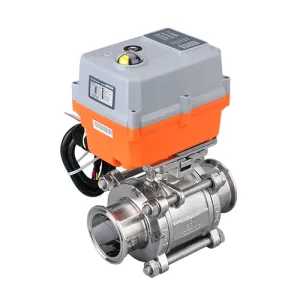
Sanitary grade electrically adjustable three-piece quick-opening ball valve
Category: Electric ValveBrowse number: 32Number:Release time: 2025-09-10 10:33:47The sanitary grade electrically adjustable three-piece quick-opening ball valve offers precise, automated flow control for hygienic applications in food, beverage, pharmaceutical, and dairy industries. Constructed from high-quality stainless steel, it ensures corrosion resistance, easy cleaning, and leak-proof performance. Its three-piece design allows simple maintenance and quick assembly, while the electric actuator enables remote operation, fast response, and accurate regulation. Ideal for pipelines requiring high hygiene standards and reliable automated control, this valve combines efficiency, safety, and long-term durability.
News
Category:
-
[Industry News]Intelligent Automatic Control Valves for Industrial Automati...
2025-11-27 09:50:17
Case
Category:
No search results found!
Video
Category:
No search results found!
Download
Category:
No search results found!
Job
Category:
No search results found!
Featured Products
No search results found!



 Phone
Phone